
Existing web agents face limitations that stem from the incontrovertible fact that these agents often depend on a single input modality and are tested in controlled environments, like web simulators or static snapshots, which don’t accurately reflect the complexity and dynamic nature of real-world web interactions. This significantly restricts their applicability and effectiveness in real-world scenarios where dynamic interactions with web content are required. This creates a niche of their practical utility, as they can not effectively navigate and interact with the varied and ever-evolving content found on actual web sites.
Previous works in web agents have focused on autonomous navigation and interaction with web environments. Key developments include WebGPT and WebAgent, which leverage GPT-3 and T5 models for text-based web browsing and HTML snippet extraction. There’s also a growing interest in multimodal web agents, like WebGUM combining T5 with Vision Transformers and PIX2ACT using web screenshots. These efforts contrast previous single-modality or simplified web environment approaches, moving towards more realistic and dynamic web interactions. Concurrently, large multimodal models (LMMs) like GPT-4V have shown robust multimodal comprehension, laying the groundwork for more sophisticated web agents.
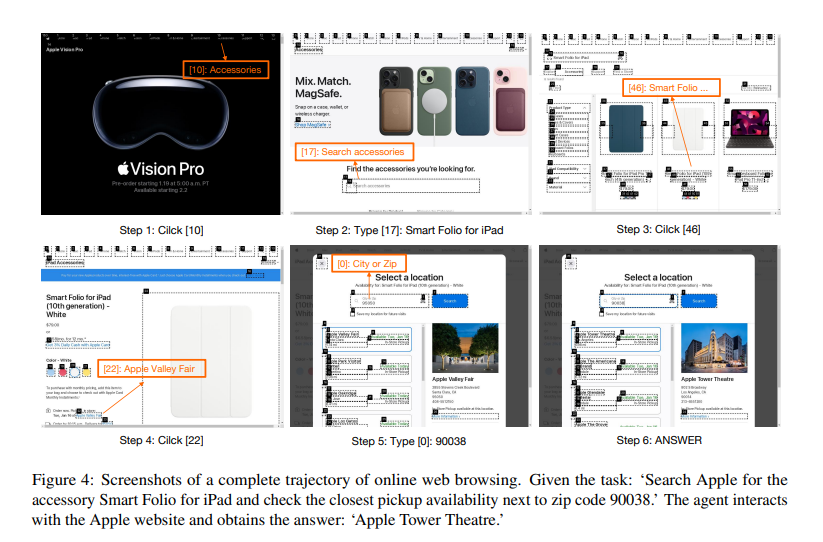
Researchers from Zhejiang University, Tencent AI Lab, and Westlake University have proposed the event of WebVoyager, an LMM powered web agent that may complete user instructions end-to-end by interacting with real-world web sites. They’ve proposed a brand new evaluation protocol that leverages the robust multimodal comprehension capabilities of GPT-4V and features a benchmark of real-world tasks from 15 widely used web sites. The agent’s interaction with the Apple website is demonstrated step-by-step, showing an optimal path without redundant actions.
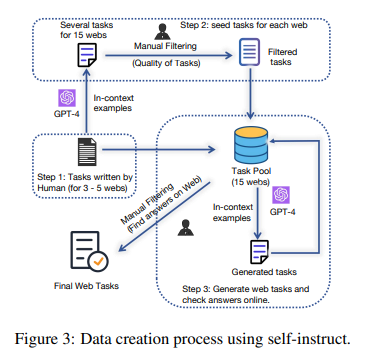
The evaluation set is constructed using a mixture of self-instruct and human verification methods. Tasks are sampled and rewritten from various web sites, ensuring top quality and relevance. Human validation is performed to confirm the generated tasks and make sure the answers could be found on the corresponding web sites. Human evaluation is the important metric, where expert annotators judge task success based on the agent’s interaction with the online. Interestingly, it utilizes GPT-4V for automatic evaluation, aiming to cut back the reliance on human evaluators and experiment costs.
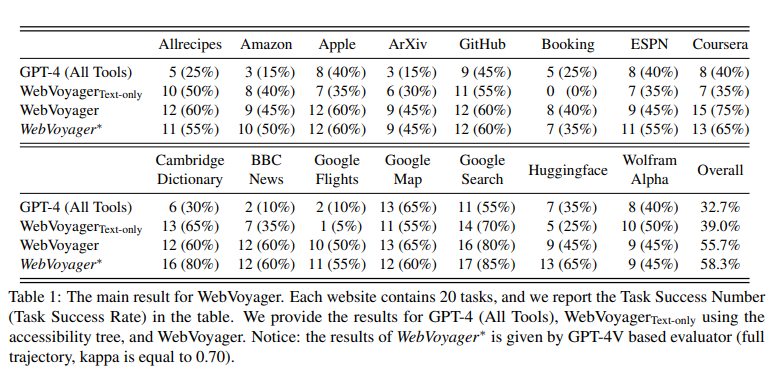
WebVoyager achieved a 55.7% task success rate, outperforming GPT-4 and its text-only variant. The automated evaluation protocol using GPT-4V aligned closely with human judgment, showing an 85.3% agreement rate. Despite its strong performance on most website tasks, WebVoyager encountered challenges with text-heavy sites like Cambridge Dictionary and Wolfram Alpha. The agent’s consistency improved with more information, reaching a Kappa rating of 0.7, matching human agreement levels, and highlighting GPT-4V’s potential for efficient, large-scale evaluations of web agents.
In conclusion, WebVoyager is an LMM-powered web agent designed for end-to-end web task resolution, with a 55.7% task success rate. Still, there’s room for improvement, as indicated by the excellent Error Evaluation provided within the paper. Researchers allude that future work should give attention to higher integration methods for visual and textual information and exploring the creation of multi-modal web agents using open-sourced LMMs.
Take a look at the Paper. All credit for this research goes to the researchers of this project. Also, don’t forget to follow us on Twitter. Join our 36k+ ML SubReddit, 41k+ Facebook Community, Discord Channel, and LinkedIn Group.
For those who like our work, you’ll love our newsletter..
Don’t Forget to affix our Telegram Channel

Nikhil is an intern consultant at Marktechpost. He’s pursuing an integrated dual degree in Materials on the Indian Institute of Technology, Kharagpur. Nikhil is an AI/ML enthusiast who’s at all times researching applications in fields like biomaterials and biomedical science. With a robust background in Material Science, he’s exploring recent advancements and creating opportunities to contribute.