
Within the dynamic field of software development, integrating large language models (LLMs) has initiated a brand new chapter, especially in code intelligence. These sophisticated models have been pivotal in automating various facets of programming, from identifying bugs to generating code, revolutionizing how coding tasks are approached and executed. The impact of those models is vast, offering to extend productivity and reduce the likelihood of errors common in manual coding processes.
Nonetheless, a major challenge on this area has been the disparity in capabilities between open-source, proprietary, and closed-source code models. While the latter have shown impressive performance, their restricted accessibility hinders broad-based research and application, resulting in a notable performance gap that needs addressing. This gap has been a barrier to the democratization of advanced coding tools, limiting the potential for widespread innovation and application in various coding scenarios.
Code models have been trained primarily on the file level, not accounting for the complex interdependencies between various files in a programming project. This has often resulted in a spot of their practical application, as real-world coding projects typically involve intricate relationships between quite a few files. Acknowledging this limitation is crucial for developing models that will not be only theoretically proficient but additionally practically applicable.
The research team from DeepSeek-AI and Peking University developed the DeepSeek-Coder series. This pioneering range of open-source code models varies from 1.3B to 33B parameters. It’s uniquely trained from the bottom up on an intensive corpus covering 87 programming languages. This development represents a major stride in bridging the present gap and enhancing the functionality of open-source models in code intelligence.
The methodology adopted by DeepSeek-Coder is especially noteworthy. These models employ a novel ‘fill-in-the-middle’ training approach and an prolonged context window capability. This approach allows the models to handle more intricate and longer code sequences, significantly enhancing their code completion capabilities. It also makes them highly versatile, enabling them to be more effectively applied in complex coding scenarios that involve multiple files and prolonged contexts. This methodological innovation is a key differentiator, setting DeepSeek-Coder aside from traditional models.

The performance of the DeepSeek-Coder models is a standout feature, demonstrating their superiority within the open-source domain. Specifically, the DeepSeek-Coder-Base 33B model consistently outperforms other open-source models across various benchmarks. Moreover, the DeepSeek-Coder-Instruct 33B variant shows remarkable leads to code-related tasks, surpassing a number of the leading closed-source models, including OpenAI’s GPT-3.5 Turbo. These results are a testament to the efficacy of the progressive training and design approach of the DeepSeek-Coder series.
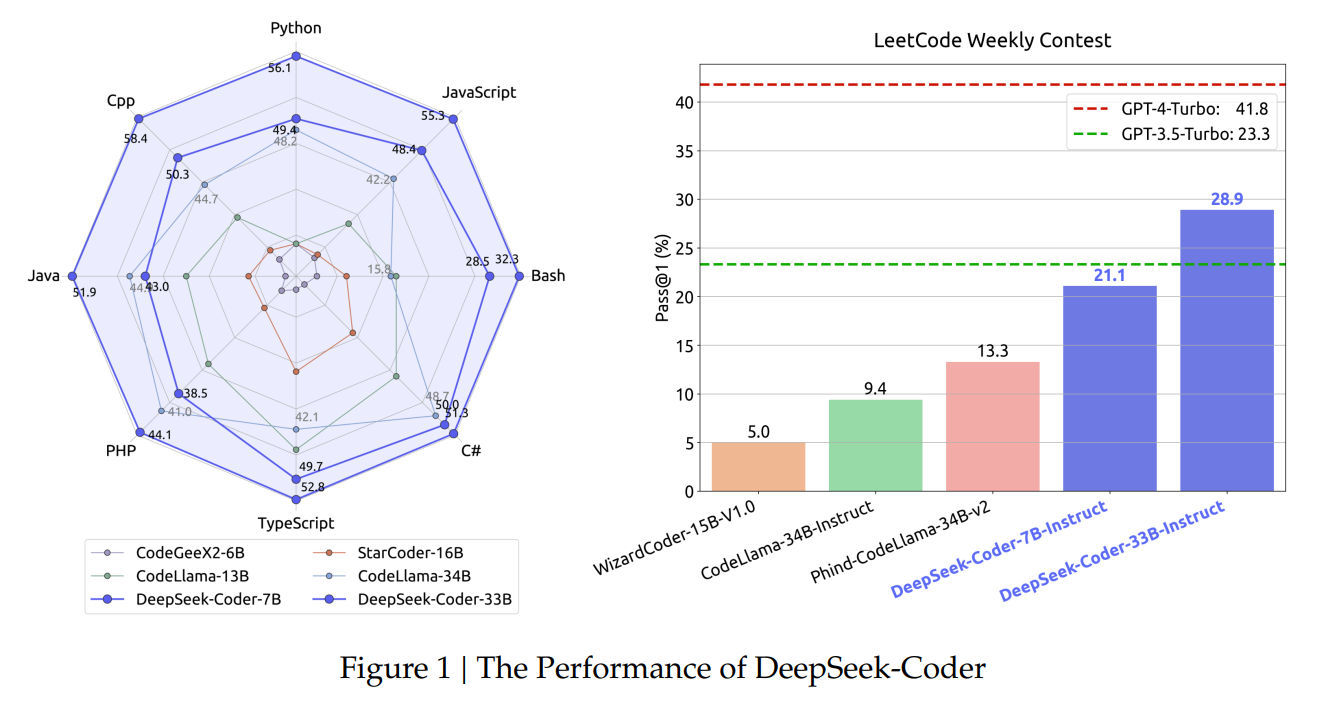
In conclusion, the DeepSeek-Coder series marks a pivotal advancement in code intelligence. By effectively addressing the gap between open-source and proprietary code models, DeepSeek-Coder sets a brand new benchmark within the performance of code models. Its ability to grasp and process complex code sequences and its proficiency in various programming languages underscores its potential to revolutionize code generation and comprehension. This development is a leap towards more accessible, efficient, and advanced coding tools, paving the way in which for broader innovation and application in software development.
Take a look at the Paper. All credit for this research goes to the researchers of this project. Also, don’t forget to follow us on Twitter and Google News. Join our 36k+ ML SubReddit, 41k+ Facebook Community, Discord Channel, and LinkedIn Group.
If you happen to like our work, you’ll love our newsletter..
Don’t Forget to affix our Telegram Channel

Muhammad Athar Ganaie, a consulting intern at MarktechPost, is a proponet of Efficient Deep Learning, with a deal with Sparse Training. Pursuing an M.Sc. in Electrical Engineering, specializing in Software Engineering, he blends advanced technical knowledge with practical applications. His current endeavor is his thesis on “Improving Efficiency in Deep Reinforcement Learning,” showcasing his commitment to enhancing AI’s capabilities. Athar’s work stands on the intersection “Sparse Training in DNN’s” and “Deep Reinforcemnt Learning”.