
Within the fast-paced world of artificial intelligence, the challenge of keeping large language models (LLMs) up-to-date with the most recent factual knowledge is paramount. These models, which have turn out to be the backbone of diverse AI applications, store a wealth of knowledge during their initial training phase. Nonetheless, as time passes, the static nature of this stored knowledge becomes a limitation, unable to accommodate the constant evolution of real-world information or focus on area of interest domains.
Recent studies have highlighted a promising approach to this problem: instruction-tuning. This method enhances the power of LLMs to access and update their knowledge base more effectively. By continuing the pre-training process with recent documents and applying instruction-tuning techniques, researchers have found significant improvements within the models’ performance. Specifically, experiments with models like Llama-2 have shown that this ongoing training can increase the accuracy of answers to specific questions by as much as 30.3%, in comparison with 27.6% without instruction tuning. This process, nonetheless, uncovers the “perplexity curse,” where despite achieving low perplexity (a measure of prediction accuracy), the models still face limits in extracting knowledge effectively from recent documents.
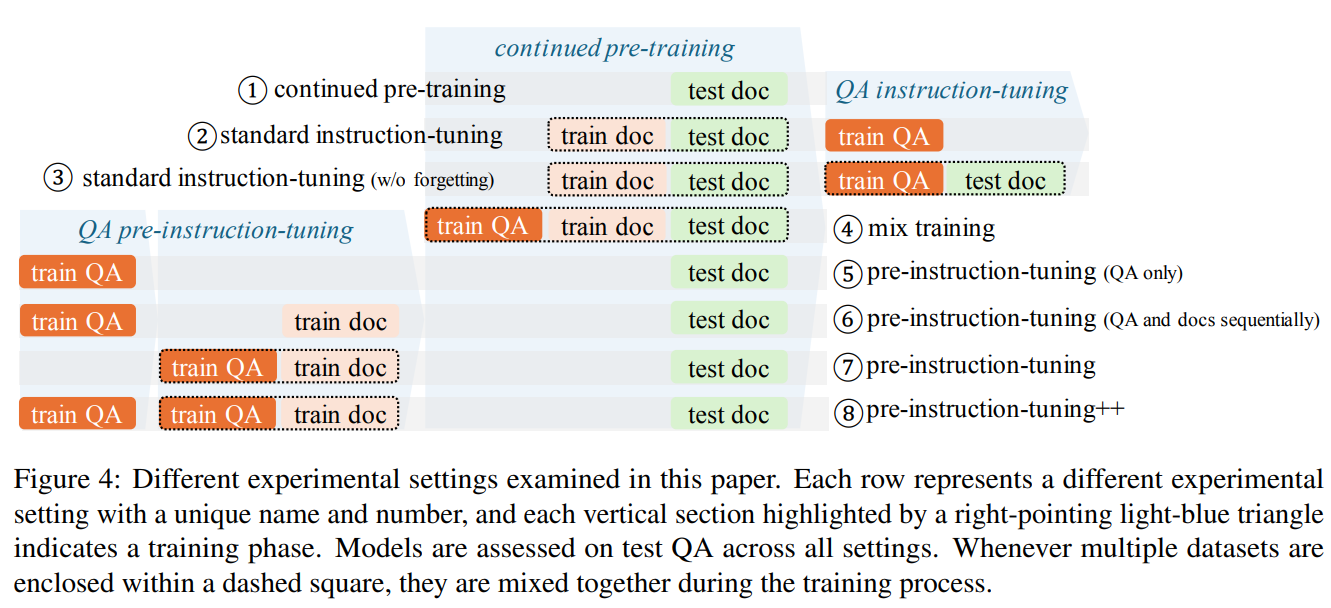
To deal with these challenges, researchers propose pre-instruction-tuning (PIT), which prioritizes exposing LLMs to question-answer (QA) pairs before engaging with more complex document materials as shown in Figure 1 and 4. This strategy is grounded within the hypothesis that understanding learn how to access knowledge through questions enhances the model’s ability to assimilate and retain recent information from detailed documents. The Wiki2023 dataset, comprising up-to-date Wikipedia articles, serves as a testbed for these experiments, revealing that models trained with a mixture of QA pairs and documents exhibit superior knowledge absorption capabilities.
Quantitative results underscore the prevalence of PIT over traditional instruction-tuning methods: PIT has led to a major increase in QA accuracies, with a 17.8% improvement for Llama-2 7B models (from 30.3% to 48.1%) and a 16.3% boost for Llama-2 70B models (from 46.4% to 62.7%). Furthermore, this method ensures that models not only memorize information but in addition truly comprehend its application, improving their ability to reply questions accurately. The introduction of pre-instruction-tuning++ (PIT++), which further refines the training process by specializing in the sequence of QA and document exposure, marks a major step forward. This method significantly enhances the model’s performance, confirming the importance of strategic training sequences in knowledge acquisition.
Overall, the research presents a compelling case for the advantages of continued pre-training and instruction-tuning in enhancing LLMs’ ability to remain current with evolving knowledge. By adopting these advanced training methodologies, models like Llama-2 show improved performance in answering questions accurately and promise greater adaptability across various domains. As we move forward, the potential to expand these techniques to encompass a broader spectrum of documents and directions opens recent avenues for achieving more resilient and versatile AI systems. Yet, the journey doesn’t end here; the exploration of those methods’ applicability to other skills like reasoning and comprehension, in addition to their effectiveness across different data types, stays an important area for future research.
Take a look at the Paper. All credit for this research goes to the researchers of this project. Also, don’t forget to follow us on Twitter and Google News. Join our 38k+ ML SubReddit, 41k+ Facebook Community, Discord Channel, and LinkedIn Group.
In case you like our work, you’ll love our newsletter..
Don’t Forget to hitch our Telegram Channel
Chances are you’ll also like our FREE AI Courses….

Vineet Kumar is a consulting intern at MarktechPost. He’s currently pursuing his BS from the Indian Institute of Technology(IIT), Kanpur. He’s a Machine Learning enthusiast. He’s enthusiastic about research and the most recent advancements in Deep Learning, Computer Vision, and related fields.