
Mobile applications are integral to day by day life, serving myriad purposes, from entertainment to productivity. Nevertheless, the complexity and variety of mobile user interfaces (UIs) often pose challenges regarding accessibility and user-friendliness. These interfaces are characterised by unique features equivalent to elongated aspect ratios and densely packed elements, including icons and texts, which conventional models struggle to interpret accurately. This gap in technology underscores the pressing need for specialised models able to deciphering the intricate landscape of mobile apps.
Existing research and methodologies in mobile UI understanding have introduced frameworks and models equivalent to the RICO dataset, Pix2Struct, and ILuvUI, specializing in structural evaluation and language-vision modeling. CogAgent leverages screen images for UI navigation, while Highlight applies vision-language models to mobile interfaces. Models like Ferret, Shikra, and Kosmos2 enhance referring and grounding capabilities but mainly goal natural images. MobileAgent and AppAgent employ MLLMs for screen navigation, indicating a growing emphasis on intuitive interaction mechanisms despite their reliance on external modules or predefined actions.
Apple researchers have introduced Ferret-UI, a model specifically developed to advance the understanding and interaction with mobile UIs. Distinguishing itself from existing models, Ferret-UI incorporates an “any resolution” capability, adapting to screen aspect ratios and specializing in fantastic details inside UI elements. This approach ensures a deeper, more nuanced comprehension of mobile interfaces.
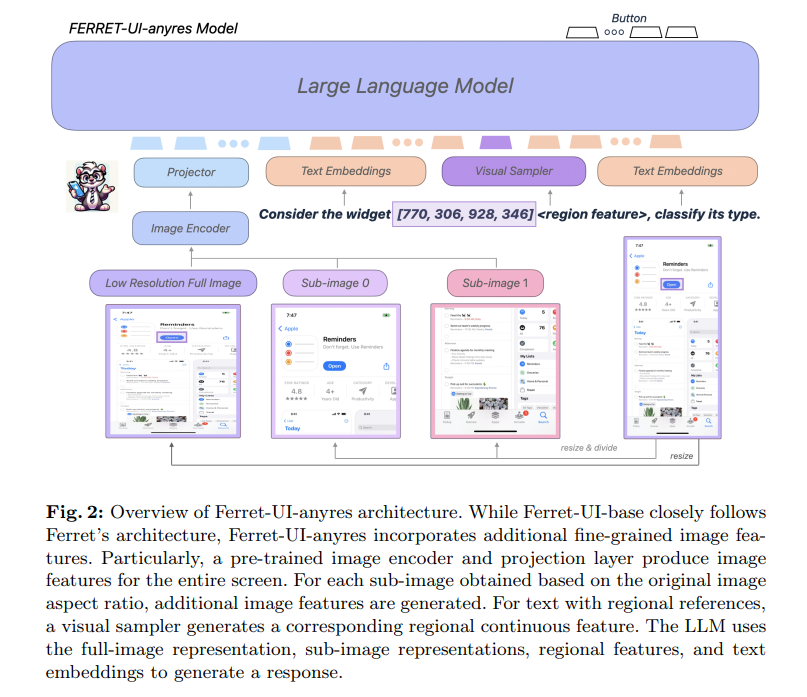
Ferret-UI’s methodology revolves around adapting its architecture for mobile UI screens, utilizing an “any resolution” strategy for handling various aspect ratios. The model processes UI screens by dividing them into sub-images, ensuring detailed element focus. Training involves the RICO dataset for Android and proprietary data for iPhone screens, covering elementary and advanced UI tasks. This includes widget classification, icon recognition, OCR, and grounding tasks like find widget and find icon, leveraging GPT-4 for generating advanced task data. The sub-images are encoded individually, using visual features of various granularity to counterpoint the model’s understanding and interaction capabilities with mobile UIs.
Ferret-UI is greater than only a promising model; it’s a proven performer. It outperformed open-source UI MLLMs and GPT-4V, exhibiting a major leap in task-specific performances. In icon recognition tasks, Ferret-UI reached an accuracy rate of 95%, a considerable 25% increase over the closest competitor model. It achieved a 90% success rate for widget classification, surpassing GPT-4V by 30%. Grounding tasks like finding widgets and icons saw Ferret-UI maintaining 92% and 93% accuracy, respectively, marking 20% and 22% improvement in comparison with existing models. These figures underline Ferret-UI’s enhanced capability in mobile UI understanding, setting recent benchmarks in accuracy and reliability for the sphere.
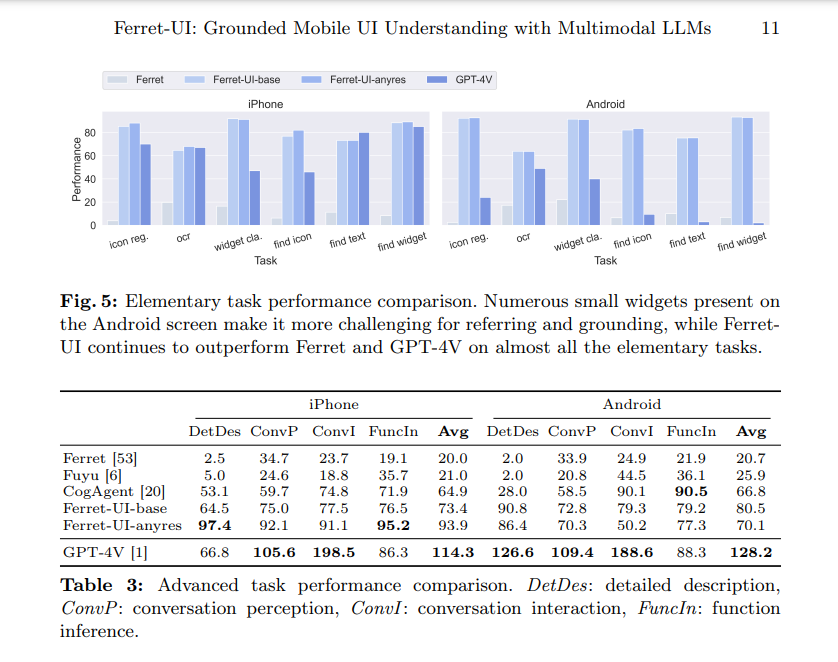
In conclusion, the research introduced Ferret-UI, Apple’s novel approach to improving mobile UI understanding through an “any resolution” strategy and a specialized training regimen. By leveraging detailed aspect-ratio adjustments and comprehensive datasets, Ferret-UI significantly advanced task-specific performance metrics, notably exceeding those of existing models. The quantitative results underscore the model’s enhanced interpretative capabilities. However it’s not only in regards to the numbers. Ferret-UI’s success illustrates the potential for more intuitive and accessible mobile app interactions, paving the best way for future advancements in UI comprehension. It’s a model that may truly make a difference in how we interact with mobile UIs.
Take a look at the Paper. All credit for this research goes to the researchers of this project. Also, don’t forget to follow us on Twitter. Join our Telegram Channel, Discord Channel, and LinkedIn Group.
In the event you like our work, you’ll love our newsletter..
Don’t Forget to affix our 40k+ ML SubReddit

Nikhil is an intern consultant at Marktechpost. He’s pursuing an integrated dual degree in Materials on the Indian Institute of Technology, Kharagpur. Nikhil is an AI/ML enthusiast who’s all the time researching applications in fields like biomaterials and biomedical science. With a powerful background in Material Science, he’s exploring recent advancements and creating opportunities to contribute.