
Over the past few years, tuning-based diffusion models have demonstrated remarkable progress across a big selection of image personalization and customization tasks. Nonetheless, despite their potential, current tuning-based diffusion models proceed to face a number of complex challenges in producing and generating style-consistent images, and there is likely to be three reasons behind the identical. First, the concept of favor still stays widely undefined and undetermined, and comprises a mixture of elements including atmosphere, structure, design, material, color, and far more. Second inversion-based methods are liable to style degradation, leading to frequent lack of fine-grained details. Finally, adapter-based approaches require frequent weight tuning for every reference image to keep up a balance between text controllability, and magnificence intensity.
Moreover, the first goal of a majority of favor transfer approaches or style image generation is to make use of the reference image, and apply its specific style from a given subset or reference image to a goal content image. Nonetheless, it’s the wide variety of attributes of favor that makes the job difficult for researchers to gather stylized datasets, representing style appropriately, and evaluating the success of the transfer. Previously, models and frameworks that cope with fine-tuning based diffusion process, fine-tune the dataset of images that share a standard style, a process that’s each time-consuming, and with limited generalizability in real-world tasks because it is difficult to collect a subset of images that share the identical or nearly an identical style.
In this text, we’ll discuss InstantStyle, a framework designed with the aim of tackling the problems faced by the present tuning-based diffusion models for image generation and customization. We are going to talk in regards to the two key strategies implemented by the InstantStyle framework:
- A straightforward yet effective approach to decouple style and content from reference images inside the feature space, predicted on the belief that features inside the same feature space will be either added to or subtracted from each other.
- Stopping style leaks by injecting the reference image features exclusively into the style-specific blocks, and deliberately avoiding the necessity to use cumbersome weights for fine-tuning, often characterizing more parameter-heavy designs.
This text goals to cover the InstantStyle framework in depth, and we explore the mechanism, the methodology, the architecture of the framework together with its comparison with cutting-edge frameworks. We may also discuss how the InstantStyle framework demonstrates remarkable visual stylization outcomes, and strikes an optimal balance between the controllability of textual elements and the intensity of favor. So let’s start.
Diffusion based text to image generative AI frameworks have garnered noticeable and noteworthy success across a big selection of customization and personalization tasks, particularly in consistent image generation tasks including object customization, image preservation, and magnificence transfer. Nonetheless, despite the recent success and boost in performance, style transfer stays a difficult task for researchers owing to the undetermined and undefined nature of favor, often including quite a lot of elements including atmosphere, structure, design, material, color, and far more. With that being said, the first goal of stylized image generation or style transfer is to use the precise style from a given reference image or a reference subset of images to the goal content image. Nonetheless, the wide variety of attributes of favor makes the job difficult for researchers to gather stylized datasets, representing style appropriately, and evaluating the success of the transfer. Previously, models and frameworks that cope with fine-tuning based diffusion process, fine-tune the dataset of images that share a standard style, a process that’s each time-consuming, and with limited generalizability in real-world tasks because it is difficult to collect a subset of images that share the identical or nearly an identical style.
With the challenges encountered by the present approach, researchers have taken an interest in developing fine-tuning approaches for style transfer or stylized image generation, and these frameworks will be split into two different groups:
- Adapter-free Approaches: Adapter-free approaches and frameworks leverage the facility of self-attention inside the diffusion process, and by implementing a shared attention operation, these models are able to extracting essential features including keys and values from a given reference style images directly.
- Adapter-based Approaches: Adapter-based approaches and frameworks however incorporate a light-weight model designed to extract detailed image representations from the reference style images. The framework then integrates these representations into the diffusion process skillfully using cross-attention mechanisms. The first goal of the combination process is to guide the generation process, and to be certain that the resulting image is aligned with the specified stylistic nuances of the reference image.
Nonetheless, despite the guarantees, tuning-free methods often encounter a couple of challenges. First, the adapter-free approach requires an exchange of key and values inside the self-attention layers, and pre-catches the important thing and value matrices derived from the reference style images. When implemented on natural images, the adapter-free approach demands the inversion of image back to the latent noise using techniques like DDIM or Denoising Diffusion Implicit Models inversion. Nonetheless, using DDIM or other inversion approaches might end in the lack of fine-grained details like color and texture, subsequently diminishing the style information within the generated images. Moreover, the extra step introduced by these approaches is a time consuming process, and might pose significant drawbacks in practical applications. Alternatively, the first challenge for adapter-based methods lies in striking the precise balance between the context leakage and magnificence intensity. Content leakage occurs when a rise within the style intensity leads to the looks of non-style elements from the reference image within the generated output, with the first point of difficulty being separating styles from content inside the reference image effectively. To handle this issue, some frameworks construct paired datasets that represent the identical object in several styles, facilitating the extraction of content representation, and disentangled styles. Nonetheless, because of the inherently undetermined representation of favor, the duty of making large-scale paired datasets is proscribed by way of the range of styles it will probably capture, and it’s a resource-intensive process as well.
To tackle these limitations, the InstantStyle framework is introduced which is a novel tuning-free mechanism based on existing adapter-based methods with the power to seamlessly integrate with other attention-based injecting methods, and achieving the decoupling of content and magnificence effectively. Moreover, the InstantStyle framework introduces not one, but two effective ways to finish the decoupling of favor and content, achieving higher style migration without having the necessity to introduce additional methods to realize decoupling or constructing paired datasets.
Moreover, prior adapter-based frameworks have been used widely within the CLIP-based methods as a picture feature extractor, some frameworks have explored the opportunity of implementing feature decoupling inside the feature space, and when put next against undetermination of favor, it is simpler to explain the content with text. Since images and texts share a feature space in CLIP-based methods, a straightforward subtraction operation of context text features and image features can reduce content leakage significantly. Moreover, in a majority of diffusion models, there’s a selected layer in its architecture that injects the style information, and accomplishes the decoupling of content and magnificence by injecting image features only into specific style blocks. By implementing these two easy strategies, the InstantStyle framework is in a position to solve content leakage problems encountered by a majority of existing frameworks while maintaining the strength of favor.
To sum it up, the InstantStyle framework employs two easy, straightforward yet effective mechanisms to realize an efficient disentanglement of content and magnificence from reference images. The Fast-Style framework is a model independent and tuning-free approach that demonstrates remarkable performance in style transfer tasks with an enormous potential for downstream tasks.
Fast-Style: Methodology and Architecture
As demonstrated by previous approaches, there’s a balance within the injection of favor conditions in tuning-free diffusion models. If the intensity of the image condition is simply too high, it would end in content leakage, whereas if the intensity of the image condition drops too low, the style may not seem like obvious enough. A significant reason behind this remark is that in a picture, the style and content are intercoupled, and resulting from the inherent undetermined style attributes, it’s difficult to decouple the style and intent. Because of this, meticulous weights are sometimes tuned for every reference image in an try and balance text controllability and strength of favor. Moreover, for a given input reference image and its corresponding text description within the inversion-based methods, inversion approaches like DDIM are adopted over the image to get the inverted diffusion trajectory, a process that approximates the inversion equation to remodel a picture right into a latent noise representation. Constructing on the identical, and ranging from the inverted diffusion trajectory together with a brand new set of prompts, these methods generate recent content with its style aligning with the input. Nonetheless, as shown in the next figure, the DDIM inversion approach for real images is usually unstable because it relies on local linearization assumptions, leading to propagation of errors, and results in lack of content and incorrect image reconstruction.

Coming to the methodology, as an alternative of employing complex strategies to disentangle content and magnificence from images, the Fast-Style framework takes the best approach to realize similar performance. In comparison against the underdetermined style attributes, content will be represented by natural text, allowing the Fast-Style framework to make use of the text encoder from CLIP to extract the characteristics of the content text as context representations. Concurrently, the Fast-Style framework implements CLIP image encoder to extract the features of the reference image. Profiting from the characterization of CLIP global features, and post subtracting the content text features from the image features, the Fast-Style framework is in a position to decouple the style and content explicitly. Even though it is an easy strategy, it helps the Fast-Style framework is sort of effective in keeping content leakage to a minimum.
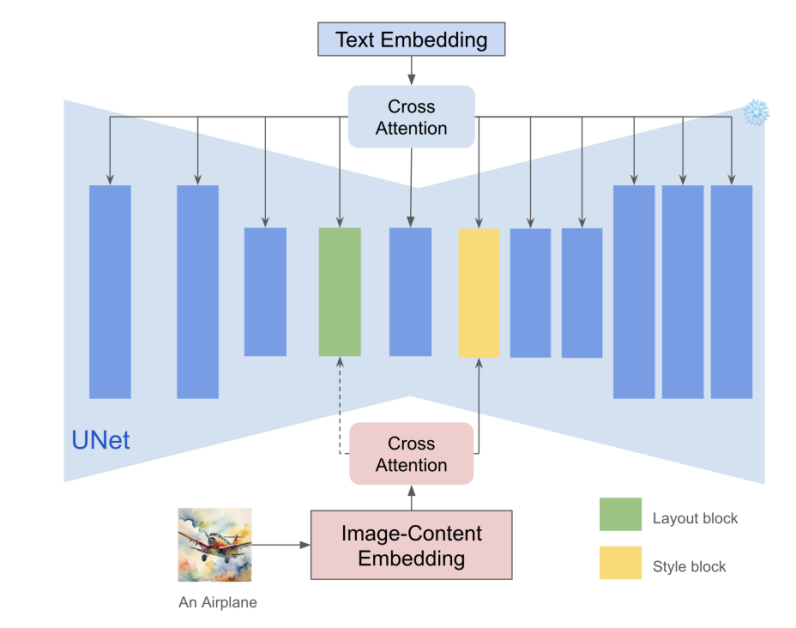
Moreover, each layer inside a deep network is answerable for capturing different semantic information, and the important thing remark from previous models is that there exist two attention layers which can be answerable for handling style. up Specifically, it’s the blocks.0.attentions.1 and down blocks.2.attentions.1 layers answerable for capturing style like color, material, atmosphere, and the spatial layout layer captures structure and composition respectively. The Fast-Style framework uses these layers implicitly to extract style information, and prevents content leakage without losing the style strength. The strategy is easy yet effective because the model has positioned style blocks that may inject the image features into these blocks to realize seamless style transfer. Moreover, because the model greatly reduces the variety of parameters of the adapter, the text control ability of the framework is enhanced, and the mechanism can also be applicable to other attention-based feature injection models for editing and other tasks.

Fast-Style : Experiments and Results
The Fast-Style framework is implemented on the Stable Diffusion XL framework, and it uses the commonly adopted pre-trained IR-adapter as its exemplar to validate its methodology, and mutes all blocks except the style blocks for image features. The Fast-Style model also trains the IR-adapter on 4 million large-scale text-image paired datasets from scratch, and as an alternative of coaching all blocks, updates only the style blocks.
To conduct its generalization capabilities and robustness, the Fast-Style framework conducts quite a few style transfer experiments with various styles across different content, and the outcomes will be observed in the next images. Given a single style reference image together with various prompts, the Fast-Style framework delivers top quality, consistent style image generation.

Moreover, because the model injects image information only within the style blocks, it’s in a position to mitigate the problem of content leakage significantly, and subsequently, doesn’t have to perform weight tuning.

Moving along, the Fast-Style framework also adopts the ControlNet architecture to realize image-based stylization with spatial control, and the outcomes are demonstrated in the next image.

In comparison against previous cutting-edge methods including StyleAlign, B-LoRA, Swapping Self Attention, and IP-Adapter, the Fast-Style framework demonstrates the perfect visual effects.

Final Thoughts
In this text, now we have talked about Fast-Style, a general framework that employs two easy yet effective strategies to realize effective disentanglement of content and magnificence from reference images. The InstantStyle framework is designed with the aim of tackling the problems faced by the present tuning-based diffusion models for image generation and customization. The Fast-Style framework implements two vital strategies: A straightforward yet effective approach to decouple style and content from reference images inside the feature space, predicted on the belief that features inside the same feature space will be either added to or subtracted from each other. Second, stopping style leaks by injecting the reference image features exclusively into the style-specific blocks, and deliberately avoiding the necessity to use cumbersome weights for fine-tuning, often characterizing more parameter-heavy designs.

