
Retrieval-Augmented Generation (RAG) is emerging as a pivotal technology in large language models (LLMs). It goals to reinforce accuracy by integrating externally retrieved information with pre-existing model knowledge. This technology is especially necessary in addressing the restrictions of LLMs confined to their training datasets. It must be equipped to handle queries about recent or nuanced information not present of their training data.
The first challenge in dynamic digital interactions involves integrating a model’s internal knowledge with accurate, timely external data. Effective RAG systems must seamlessly incorporate these elements to deliver precise responses, navigating the usually conflicting data without compromising the reliability of the output.
Existing work includes the RAG model, which boosts generative models with real-time data retrieval to enhance response accuracy and relevance. The Generation-Augmented Retrieval framework integrates dynamic retrieval with generative capabilities, significantly improving factual accuracy in responses. Commercially, models like ChatGPT and Gemini utilize retrieval-augmented approaches to complement user interactions with current search results. Efforts to evaluate the performance of those systems include rigorous benchmarks and automatic evaluation frameworks, specializing in the operational characteristics and reliability of RAG systems in practical applications.
Stanford researchers have introduced a scientific approach to analyzing how LLMs, specifically GPT-4, integrate and prioritize external information retrieved through RAG systems. What sets this method apart is its concentrate on the interplay between a model’s pre-trained knowledge and the accuracy of external data, using variable perturbations to simulate real-world inaccuracies. This evaluation provides an understanding of the model’s adaptability, an important think about practical applications where data reliability can vary significantly.
The methodology involved posing inquiries to GPT-4, each with and without perturbed external documents as context. Datasets utilized included drug dosages, sports statistics, and current news events, allowing a comprehensive evaluation across various knowledge domains. Each dataset was manipulated to incorporate variations in data accuracy, assessing the model’s responses based on how well it could discern and prioritize information depending on its fidelity to known facts. The researchers employed each “strict” and “loose” prompting strategies to explore how various kinds of RAG deployment impact the model’s reliance on its pre-trained knowledge versus the altered external information. This process highlighted the model’s reliance on its internal expertise versus retrieved content, offering insights into the strengths and limitations of current RAG implementations.
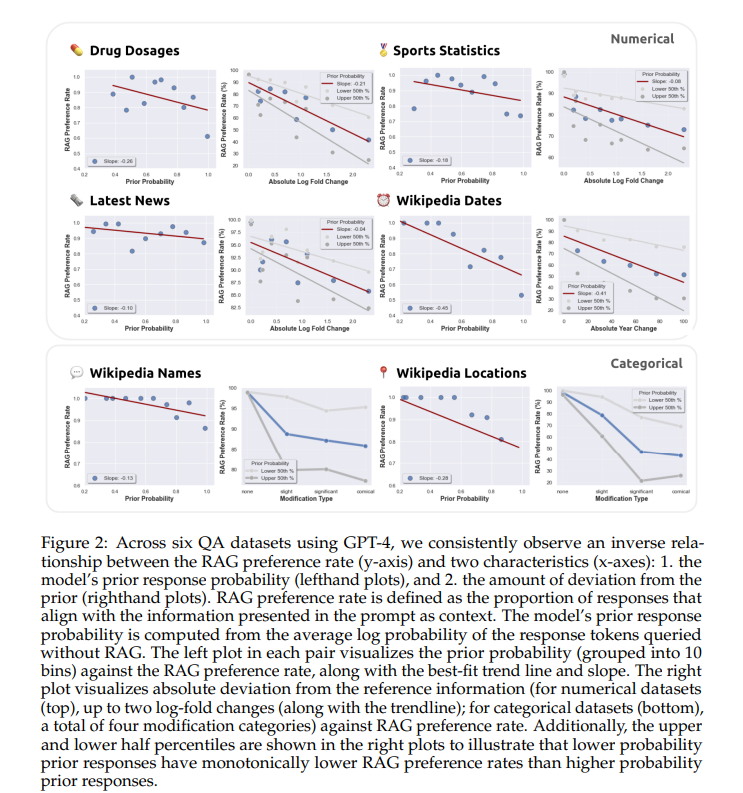
The study found that when correct information was provided, GPT-4 corrected its initial errors in 94% of cases, significantly enhancing response accuracy. Nonetheless, when external documents were perturbed with inaccuracies, the model’s reliance on flawed data increased, especially when its internal knowledge was less robust. For instance, with growing deviation in the info, the model’s preference for external information over its knowledge dropped noticeably, with an observed decline in correct response adherence by as much as 35% because the perturbation level increased. This demonstrated a transparent correlation between data accuracy and the effectiveness of RAG systems.
In conclusion, this research thoroughly analyzes RAG systems in LLMs, specifically exploring the balance between internally stored knowledge and externally retrieved information. The study reveals that while RAG systems significantly improve response accuracy when supplied with correct data, their effectiveness diminishes with inaccurate external information. These insights underline the importance of enhancing RAG system designs to discriminate higher and integrate external data, ensuring more reliable and robust model performance across varied real-world applications.
Take a look at the Paper. All credit for this research goes to the researchers of this project. Also, don’t forget to follow us on Twitter. Join our Telegram Channel, Discord Channel, and LinkedIn Group.
When you like our work, you’ll love our newsletter..
Don’t Forget to affix our 40k+ ML SubReddit
For Content Partnership, Please Fill Out This Form Here..

Nikhil is an intern consultant at Marktechpost. He’s pursuing an integrated dual degree in Materials on the Indian Institute of Technology, Kharagpur. Nikhil is an AI/ML enthusiast who’s all the time researching applications in fields like biomaterials and biomedical science. With a powerful background in Material Science, he’s exploring latest advancements and creating opportunities to contribute.