
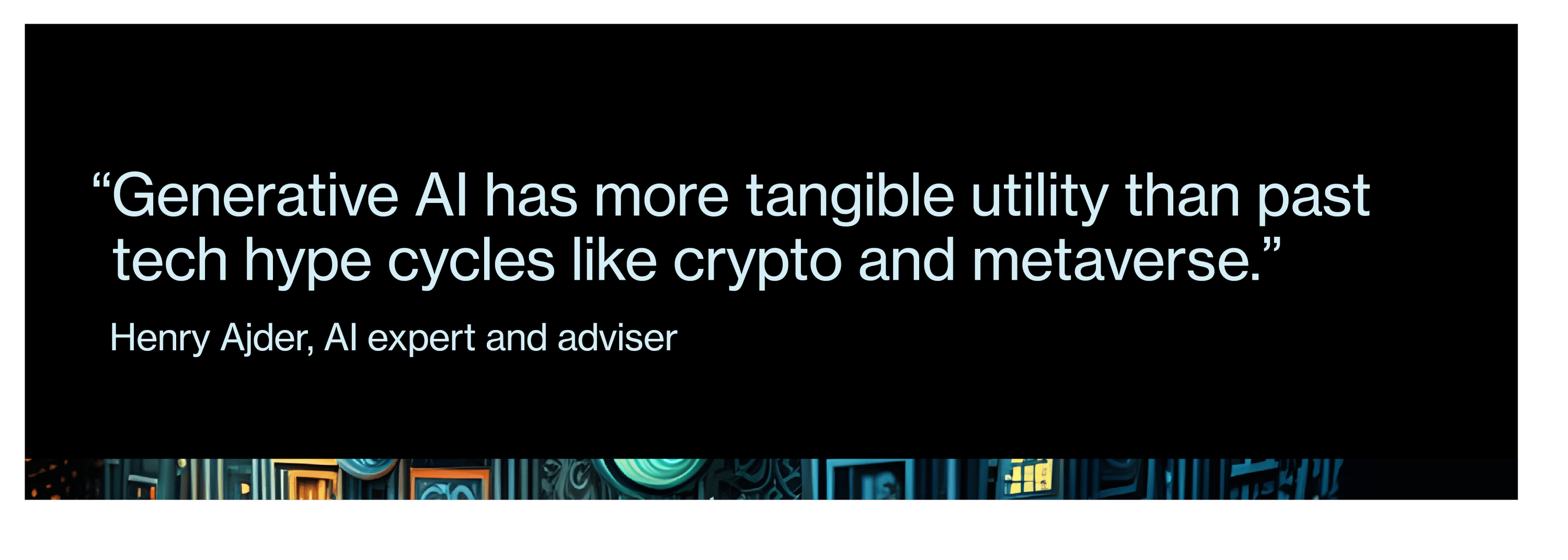
After a procession of overhyped technologies like Web3, the metaverse, and blockchain, executives are bracing for the tidal wave of generative AI, a shift some consider to be on par with the appearance of the web or the desktop computer. But with power comes responsibility, and generative AI offers as much risk as reward. The technology is testing legal regimes in copyright and mental property, creating recent cyber and data governance threats, and setting off automation anxiety within the workforce.
Generative AI deployment: Strategies for smooth scaling
-
Download the report
Organizations must move quickly to maintain up with stakeholder expectations, yet they have to proceed rigorously to make sure they don’t fall foul of regulations or ethical standards in areas like data privacy and bias. Operationally, enterprises must reconfigure their workforce and forge partnerships with tech firms to design protected, effective, and reliable generative AI.
To gauge the considering of business decision-makers at this crossroads, MIT Technology Review Insights polled 1,000 executives about their current and expected generative AI use cases, implementation barriers, technology strategies, and workforce planning. Combined with insights from an authority interview panel, this poll offers a view into today’s major strategic considerations for generative AI, helping executives reason through the main decisions they’re being called upon to make.
Key findings from the poll and interviews include the next:
- Executives recognize the transformational potential of generative AI, but they’re moving cautiously to deploy. Nearly all firms imagine generative AI will affect their business, with a mere 4% saying it can not affect them. But at this point, only 9% have fully deployed a generative AI use case of their organization. This figure is as little as 2% in the federal government sector, while financial services (17%) and IT (28%) are the almost certainly to have deployed a use case. The most important hurdle to deployment is knowing generative AI risks, chosen as a top-three challenge by 59% of respondents.
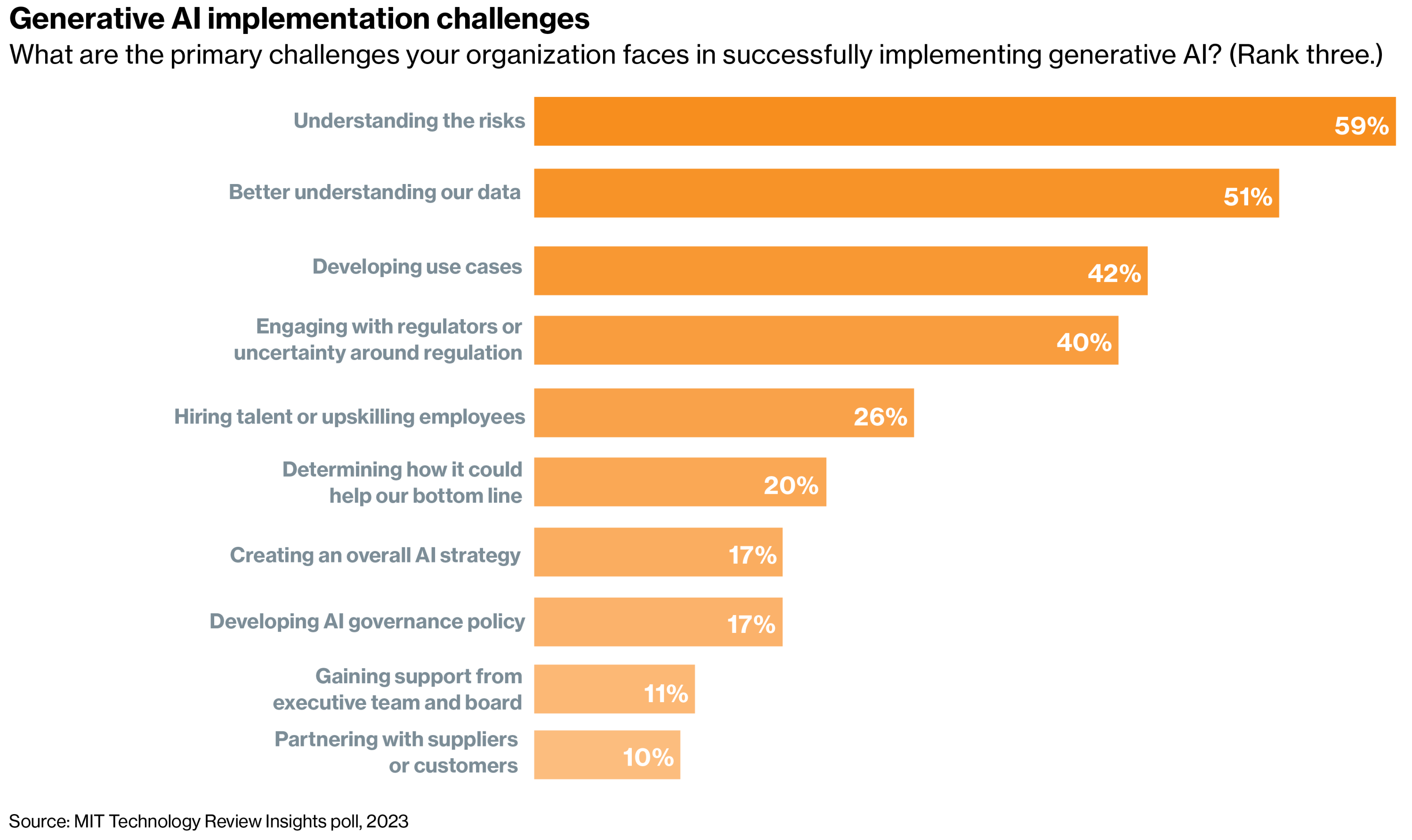
- Firms won’t go it alone: Partnerships with each startups and Big Tech will likely be critical to smooth scaling. Most executives (75%) plan to work with partners to bring generative AI to their organization at scale, and only a few (10%) consider partnering to be a top implementation challenge, suggesting that a robust ecosystem of providers and services is on the market for collaboration and co-creation. While Big Tech, as developers of generative AI models and purveyors of AI-enabled software, has an ecosystem advantage, startups enjoy benefits in several specialized niches. Executives are somewhat more prone to plan to team up with small AI-focused firms (43%) than large tech firms (32%).
- Access to generative AI will likely be democratized across the economy. Company size has no bearing on a firm’s likelihood to be experimenting with generative AI, our poll found. Small firms (those with annual revenue lower than $500 million) were 3 times more likely than mid-sized firms ($500 million to $1 billion) to have already deployed a generative AI use case (13% versus 4%). Actually, these small firms had deployment and experimentation rates much like those of the very largest firms (those with revenue greater than $10 billion). Inexpensive generative AI tools could boost smaller businesses in the identical way as cloud computing, which granted firms access to tools and computational resources that might once have required huge financial investments in hardware and technical expertise.
- One-quarter of respondents expect generative AI’s primary effect to be a discount of their workforce. The figure was higher in industrial sectors like energy and utilities (43%), manufacturing (34%), and transport and logistics (31%). It was lowest in IT and telecommunications (7%). Overall, this can be a modest figure in comparison with the more dystopian job alternative scenarios in circulation. Demand for skills is increasing in technical fields that give attention to operationalizing AI models and in organizational and management positions tackling thorny topics including ethics and risk. AI is democratizing technical skills across the workforce in ways in which could lead on to recent job opportunities and increased worker satisfaction. But experts caution that, if deployed poorly and without meaningful consultation, generative AI could degrade the qualitative experience of human work.
- Regulation looms, but uncertainty is today’s biggest challenge. Generative AI has spurred a flurry of activity as legislators attempt to get their arms across the risks, but truly impactful regulation will move on the speed of presidency. Within the meantime, many business leaders (40%) consider engaging with regulation or regulatory uncertainty a primary challenge of generative AI adoption. This varies greatly by industry, from a high of 54% in government to a low of 20% in IT and telecommunications.