
With the widespread attention, and potential applications of blockchain and artificial intelligence technologies, the privacy protection techniques that arise as a direct results of integration of the 2 technologies is gaining notable significance. These privacy protection techniques not only protect the privacy of people, but in addition they guarantee the dependability and security of the information.
In this text, we can be talking about how the collaboration between AI and blockchain gives birth to quite a few privacy protection techniques, and their application in numerous verticals including de-identification, data encryption, k-anonymity, and multi-tier distributed ledger methods. Moreover, we may also try to investigate the deficiencies together with their actual cause, and offer solutions accordingly.
The blockchain network was first introduced to the world when in 2008 Nakamoto introduced Bitcoin, a cryptocurrency built on the blockchain network. Ever since its introduction, blockchain has gained a number of popularity, especially up to now few years. The worth at which Bitcoin is trading today, and it crossing the Trillion-dollar market cap mark indicates that blockchain has the potential to generate substantial revenue and profits for the industry.
Blockchain technology could be categorized totally on the idea of the extent of accessibility and control they provide, with Public, Private, and Federated being the three most important varieties of blockchain technologies. Popular cryptocurrencies and blockchain architectures like Bitcoin and Ethereum are public blockchain offerings as they’re decentralized in nature, they usually allow nodes to enter or exit the network freely, and thus promotes maximum decentralization.
The next figure depicts the structure of Ethereum because it utilizes a linked list to ascertain connections between different blocks. The header of the block stores the hash address of the preceding block with a purpose to establish a linkage between the 2 successive blocks.
The event, and implementation of the blockchain technology is followed with legitimate security and privacy concerns in various fields that can not be neglected. For instance, a knowledge breach within the financial industry can lead to heavy losses, while a breach in military or healthcare systems could be disastrous. To stop these scenarios, protection of knowledge, user assets, and identity information has been a serious focus of the blockchain security research community, as to make sure the event of the blockchain technology, it is crucial to keep up its security.
Ethereum is a decentralized blockchain platform that upholds a shared ledger of data collaboratively using multiple nodes. Each node within the Ethereum network makes use of the EVM or Ethereum Vector Machine to compile smart contracts, and facilitate the communication between nodes that occur via a P2P or peer-to-peer network. Each node on the Ethereum network is supplied with unique functions, and permissions, although all of the nodes could be used for gathering transactions, and fascinating in block mining. Moreover, it’s value noting that compared to Bitcoin, Ethereum displays faster block generation speeds with a lead of nearly 15 seconds. It implies that crypto miners have a greater probability at acquiring rewards quicker while the interval time for verifying transactions is reduced significantly.
Alternatively, AI or Artificial Intelligence is a branch in modern science that focuses on developing machines which might be able to decision-making, and may simulate autonomous pondering comparable to a human’s ability. Artificial Intelligence is a really vast branch in itself with quite a few subfields including deep learning, computer vision, natural language processing, and more. NLP specifically has been a subfield that has been focussed heavily up to now few years that has resulted in the event of some top-notch LLMs like GPT and BERT. NLP is headed towards near perfection, and the ultimate step of NLP is processing text transformations that could make computers comprehensible, and up to date models like ChatGPT built on GPT-4 indicated that the research is headed towards the precise direction.
One other subfield that is sort of popular amongst AI developers is deep learning, an AI technique that works by imitating the structure of neurons. In a traditional deep learning framework, the external input information is processed layer by layer by training hierarchical network structures, and it’s then passed on to a hidden layer for final representation. Deep learning frameworks could be classified into two categories: Supervised learning, and Unsupervised learning.

The above image depicts the architecture of deep learning perceptron, and as it could be seen within the image, a deep learning framework employs a multiple-level neural network architecture to learn the features in the information. The neural network consists of three varieties of layers including the hidden layer, the input payer, and the output layer. Each perceptron layer within the framework is connected to the following layer with a purpose to form a deep learning framework.
Finally, now we have the combination of blockchain and artificial intelligence technologies as these two technologies are being applied across different industries and domains with a rise in the priority regarding cybersecurity, data security, and privacy protection. Applications that aim to integrate blockchain and artificial intelligence manifest the combination in the next facets.
- Utilizing blockchain technology to record and store the training data, input and output of the models, and parameters, ensuring accountability, and transparency in model audits.
- Using blockchain frameworks to deploy AI models to attain decentralization services amongst models, and enhancing the scalability and stability of the system.
- Providing secure access to external AI data and models using decentralized systems, and enabling blockchain networks to accumulate external information that’s reliable.
- Using blockchain-based token designs and incentive mechanisms to ascertain connections and trust-worthy interactions between users and AI model developers.
Privacy Protection Through the Integration of Blockchain and AI Technologies
In the present scenario, data trust systems have certain limitations that compromise the reliability of the information transmission. To challenge these limitations, blockchain technologies could be deployed to ascertain a dependable and secure data sharing & storage solution that provides privacy protection, and enhances data security. A few of the applications of blockchain in AI privacy protection are mentioned in the next table.
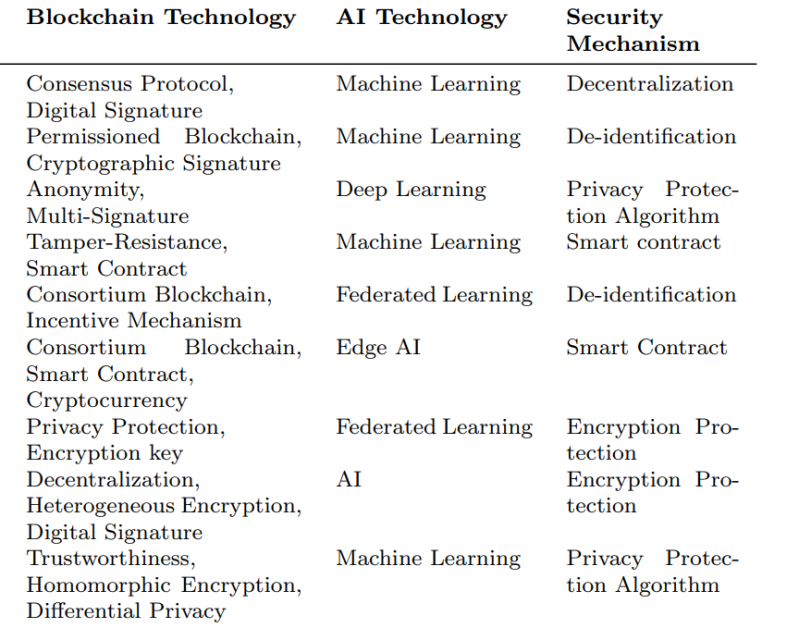
By enhancing the implementation & integration of those technologies, the protective capability & security of current data trust systems could be boosted significantly.
Data Encryption
Traditionally, data sharing and data storing methods have been vulnerable to security threats because they’re depending on centralized servers that makes them an easily identifiable goal for attackers. The vulnerability of those methods gives rise to serious complications similar to data tampering, and data leaks, and given the present security requirements, encryption methods alone will not be sufficient to make sure the security & security of the information, which is the most important reason behind the emergence of privacy protection technologies based on the combination of artificial intelligence & blockchain.
Let’s have a take a look at a blockchain-based privacy preserving federated learning scheme that goals to enhance the Multi-Krum technique, and mix it with homomorphic encryption to attain ciphertext-level model filtering and model aggregation that may confirm local models while maintaining privacy protection. The Paillier homomorphic encryption technique is utilized in this method to encrypt model updates, and thus providing additional privacy protection. The Paillier algorithm works as depicted.

De-Identification
De-Identification is a technique that is often used to anonymize personal identification information of a user in the information by separating the information from the information identifiers, and thus reducing the danger of knowledge tracking. There exists a decentralized AI framework built on permissioned blockchain technology that uses the above mentioned approach. The AI framework essentially separates the private identification information from non-personal information effectively, after which stores the hash values of the private identification information within the blockchain network. The proposed AI framework could be utilized within the medical industry to share medical records & information of a patient without revealing his/her true identity. As depicted in the next image, the proposed AI framework uses two independent blockchain for data requests with one blockchain network storing the patient’s information together with data access permissions whereas the second blockchain network captures audit traces of any requests or queries made by requesters. In consequence, patients still have complete authority and control over their medical records & sensitive information while enabling secure & secure data sharing inside multiple entities on the network.
Multi-Layered Distributed Ledger
A multi-layered distributed ledger is a knowledge storage system with decentralization property and multiple hierarchical layers which might be designed to maximise efficiency, and secure the information sharing process together with enhanced privacy protection. DeepLinQ is a blockchain-based multi-layered decentralized distributed ledger that addresses a user’s concern regarding data privacy & data sharing by enabling privacy-protected data privacy. DeepLinQ archives the promised data privacy by employing various techniques like on-demand querying, access control, proxy reservation, and smart contracts to leverage blockchain network’s characteristics including consensus mechanism, complete decentralization, and anonymity to guard data privacy.
K-Anonymity
The K-Anonymity method is a privacy protection method that goals to focus on & group individuals in a dataset in a way that each group has a minimum of K individuals with similar attribute values, and due to this fact protecting the identity & privacy of individual users. The K-Anonymity method has been the idea of a proposed reliable transactional model that facilitates transactions between energy nodes, and electric vehicles. On this model, the K-Anonymity method serves two functions: first, it hides the placement of the EVs by constructing a unified request using K-Anonymity techniques that conceal or hide the placement of the owner of the automobile; second, the K-Anonymity method conceals user identifiers in order that attackers will not be left with the choice to link users to their electric vehicles.
Evaluation and Situation Evaluation
On this section, we can be talking about comprehensive evaluation and evaluation of ten privacy protection systems using the fusion of blockchain and AI technologies which have been proposed in recent times. The evaluation focuses on five major characteristics of those proposed methods including: authority management, data protection, access control, scalability and network security, and likewise discusses the strengths, weaknesses, and potential areas of improvement. It is the unique features resulting from the combination of AI and blockchain technologies which have paved ways for brand spanking new ideas, and solutions for enhanced privacy protection. For reference, the image below shows different evaluation metrics employed to derive the analytical results for the combined application of the blockchain and AI technologies.

Authority Management
Access control is a security & privacy technology that’s used to limit a user’s access to authorized resources on the idea of pre-defined rules, set of instructions, policies, safeguarding data integrity, and system security. There exists an intelligent privacy parking management system that makes use of a Role-Based Access Control or RBAC model to administer permissions. Within the framework, each user is assigned a number of roles, and are then classified in keeping with roles that enables the system to regulate attribute access permissions. Users on the network could make use of their blockchain address to confirm their identity, and get attribute authorization access.
Access Control
Access control is certainly one of the important thing fundamentals of privacy protection, restricting access based on group membership & user identity to be certain that it is just the authorized users who can access specific resources that they’re allowed to access, and thus protecting the system from unwanted to forced access. To make sure effective and efficient access control, the framework needs to think about multiple aspects including authorization, user authentication, and access policies.
Digital Identity Technology is an emerging approach for IoT applications that may provide secure & secure access control, and ensure data & device privacy. The tactic proposes to make use of a series of access control policies which might be based on cryptographic primitives, and digital identity technology or DIT to guard the safety of communications between entities similar to drones, cloud servers, and Ground Station Servers (GSS). Once the registration of the entity is accomplished, credentials are stored within the memory. The table included below summarizes the varieties of defects within the framework.

Data Protection
Data protection is used to consult with measures including data encryption, access control, security auditing, and data backup to be certain that the information of a user shouldn’t be accessed illegally, tampered with, or leaked. In the case of data processing, technologies like data masking, anonymization, data isolation, and data encryption could be used to guard data from unauthorized access, and leakage. Moreover, encryption technologies similar to homomorphic encryption, differential privacy protection, digital signature algorithms, asymmetric encryption algorithms, and hash algorithms, can prevent unauthorized & illegal access by non-authorized users and ensure data confidentiality.
Network Security
Network security is a broad field that encompasses different facets including ensuring data confidentiality & integrity, stopping network attacks, and protecting the system from network viruses & malicious software. To make sure the security, reliability, and security of the system, a series of secure network architectures and protocols, and security measures must be adopted. Moreover, analyzing and assessing various network threats and coming up with corresponding defense mechanisms and security strategies are essential to enhance the reliability & security of the system.

Scalability
Scalability refers to a system’s ability to handle larger amounts of knowledge or an increasing variety of users. When designing a scalable system, developers must consider system performance, data storage, node management, transmission, and several other other aspects. Moreover, when ensuring the scalability of a framework or a system, developers must bear in mind the system security to stop data breaches, data leaks, and other security risks.
Developers have designed a system in compliance with European General Data Protection Rules or GDPR by storing privacy-related information, and artwork metadata in a distributed file system that exists off the chain. Artwork metadata and digital tokens are stored in OrbitDB, a database storage system that uses multiple nodes to store the information, and thus ensures data security & privacy. The off-chain distributed system disperses data storage, and thus improves the scalability of the system.

Situation Evaluation
The amalgamation of AI and blockchain technologies has resulted in developing a system that focuses heavily on protecting the privacy, identity, and data of the users. Although AI data privacy systems still face some challenges like network security, data protection, scalability, and access control, it’s crucial to think about and weigh these issues on the idea of practical considerations in the course of the design phase comprehensively. Because the technology develops and progresses further, the applications expand, the privacy protection systems built using AI & blockchain will draw more attention within the upcoming future. On the idea of research findings, technical approaches, and application scenarios, they could be classified into three categories.
- Privacy protection method application within the IoT or Web of Things industry by utilizing each blockchain and AI technology.
- Privacy protection method application in smart contract and services that make use of each blockchain and AI technology.
- Large-scale data evaluation methods that provide privacy protection by utilizing each blockchain and AI technology.
The technologies belonging to the primary category concentrate on the implementation of AI and blockchain technologies for privacy protection within the IoT industry. These methods use AI techniques to investigate high volumes of knowledge while making the most of decentralized & immutable features of the blockchain network to make sure authenticity and security of the information.
The technologies falling within the second category concentrate on fusing AI & Blockchain technologies for enhanced privacy protection by making use of blockchain’s smart contract & services. These methods mix data evaluation and data processing with AI and use blockchain technology alongside to scale back dependency on trusted third parties, and record transactions.
Finally, the technologies falling within the third category concentrate on harnessing the ability of AI and blockchain technology to attain enhanced privacy protection in large-scale data analytics. These methods aim to take advantage of blockchain’s decentralization, and immutability properties that make sure the authenticity & security of knowledge while AI techniques make sure the accuracy of knowledge evaluation.
Conclusion
In this text, now we have talked about how AI and Blockchain technologies could be utilized in sync with one another to reinforce the applications of privacy protection technologies by talking about their related methodologies, and evaluating the five primary characteristics of those privacy protection technologies. Moreover, now we have also talked concerning the existing limitations of the present systems. There are specific challenges in the sphere of privacy protection technologies built upon blockchain and AI that also must be addressed like how one can strike a balance between data sharing, and privacy preservation. The research on how one can effectively merge the capabilities of AI and Blockchain techniques is occurring, and listed here are several other ways in which could be used to integrate other techniques.
Edge computing goals to attain decentralization by leveraging the ability of edge & IoT devices to process private & sensitive user data. Because AI processing makes it mandatory to make use of substantial computing resources, using edge computing methods can enable the distribution of computational tasks to edge devices for processing as an alternative of migrating the information to cloud services, or data servers. Because the data is processed much nearer the sting device itself, the latency time is reduced significantly, and so is the network congestion that enhances the speed & performance of the system.
Multi-chain mechanisms have the potential to resolve single-chain blockchain storage, and performance issues, due to this fact boosting the scalability of the system. The combination of multi-chain mechanisms facilitates distinct attributes & privacy-levels based data classification, due to this fact improving storage capabilities and security of privacy protection systems.