
In partnership withDatabricks
Enterprise adoption of AI is able to shift into higher gear. The capabilities of generative AI have captured management attention across the organization, and technology executives are moving quickly to deploy or experiment with it. Many organizations intend to extend their spending on the broader family of AI capabilities and the info infrastructure that supports them by double digits through the next yr. And notwithstanding concerns about unfavorable economic conditions, executives see opportunities to leverage data and AI to deliver more growth to their organizations, to each the highest and bottom lines.
Laying the muse for data- and AI-led growth
-
Download the report
Based on a worldwide survey of 600 technology leaders and a series of in-depth interviews, this report finds that organizations are sharply focused on retooling for an information and AI-driven future. Every little thing from data architecture to AI-enabled automation is on the table, as technology executives strive to seek out latest efficiencies and latest sources of growth. At the identical time, the pressure to democratize the ability of knowledge and AI creates renewed urgency to bolster data governance and security.
Following are the study’s key findings:
- CIOs are doubling down on their investments in data and AI. Faced with increasing audience expectations, latest competitive pressures, a difficult economic backdrop, and an unprecedented speed of innovation, technology leaders need their data and AI assets to deliver more growth to the business than ever before. They’re investing to secure this future: every organization surveyed will boost its spending on modernizing data infrastructure and adopting AI through the next yr, and for nearly half (46%), the rise will exceed 25%.
- Consolidation of knowledge and AI systems is a priority. The proliferation of knowledge and AI systems is especially extensive within the survey’s largest organizations (those with annual revenue of greater than $10 billion). Amongst these, 81% operate 10 or more of those systems, and 28% use greater than 20. The executives we interviewed aim to pare down their multiple systems, connecting data from across the enterprise in unified platforms to interrupt down silos and enable AI initiatives to scale.
- Democratization of AI raises the stakes for governance. As business units and their staff clamor to make use of generative AI, executives seek assurance that governance frameworks for the technology can provide not only the needed data accuracy and integrity but additionally adequate data privacy and security. That’s probably why 60% of respondents say a single governance model for data and AI is “very essential.”
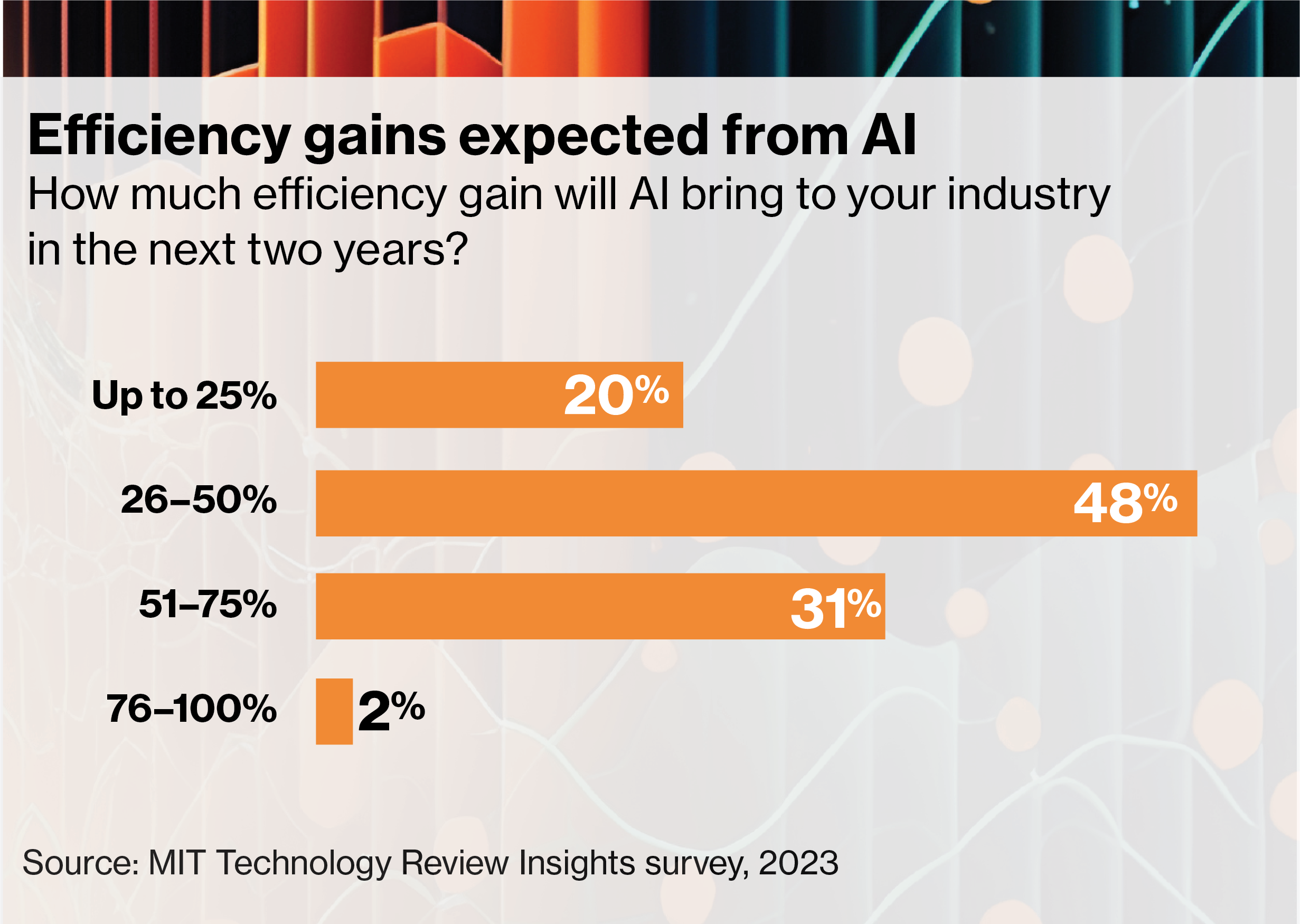
- Executives expect AI adoption to be transformative within the short term. Eighty percent of survey respondents expect AI to spice up efficiency of their industry by a minimum of 25% in the following two years. One-third say the gain will probably be a minimum of 50%.
- As generative AI spreads, flexible approaches are favored. Eighty-eight percent of organizations are using generative AI, with one-quarter (26%) investing in and adopting it and one other 62% experimenting with it. The bulk (58%) are taking a hybrid approach to developing these capabilities, using vendors’ large language models (LLMs) for some use cases and constructing their very own models when IP ownership, privacy, security, and accuracy requirements are tighter.
- Lakehouse has develop into the info architecture of alternative for the era of generative AI. Nearly three-quarters of surveyed organizations have adopted a lakehouse architecture, and just about all of the remainder expect to achieve this in the following three years. Survey respondents say they need their data architecture to support streaming data workloads for real-time analytics (a capability deemed “very essential” by 72%), easy integration of emerging technologies (66%), and sharing of live data across platforms (64%). Ninety-nine percent of lakehouse adopters say the architecture helps them achieve their data and AI goals, and 74% say the assistance is “significant.”
- Investment in people will unlock more value from data and AI. In our survey, talent and skills gaps overshadow organizations’ other data and AI challenges. When asked where their company’s data strategy needs to enhance, the biggest share of respondents (39%) say investing in talent. The number-one difficulty they face with their data and AI platforms, with 40% citing this as a top concern, is training and upskilling staff to make use of them.
A subsequent report will examine these survey leads to detail, accompanied by insights from additional executive interviews across six sectors: financial services, health care and life sciences, retail and consumer packaged goods, manufacturing, media and entertainment, and government.