
Large Language Models (LLMs) have succeeded in several different reasoning tasks. To ensure that the intended aim is met, it is typically required to iteratively adjust the LLM results since the output is simply occasionally accurate on the primary try. These refinement techniques assume that consecutive results (from the identical model, an external model, or some tool) end in improved performance. Nevertheless, there isn’t a assurance that later versions will at all times be higher as Figure 1 shows, refining might end in a false positive. This encourages the model to decide on an earlier end result using the choice technique. Moreover, prior research on iterative refining incessantly uses a single, fixed reasoning technique. But humans are more adaptable.
Figure 1: A case study illustrative of how Conditional Resampling (also generally known as “refinement”) may end in improper modification of the initial response. The unique response, which on this case is the appropriate one, could also be chosen by a variety module rather than the alteration.
A product manager may use a brainstorming technique to generate several ideas before switching to a prioritization technique to rank them based on their viability or effect. Similarly, a student preparing for an exam might use deductive reasoning to reply issues and inductive reasoning to verify the outcomes. They thus suggest a modular strategy for answering refinements, enabling us to try various tactics. On this paper, researchers from ETH Zurich and Microsoft Semantic Machines present SCREWS, a modular framework for reasoning about changes. Sampling, Conditional Resampling, and Selection are the three core components of the architecture which can be introduced intimately in Figure 2. They instantiate SCREWS by fixing the submodules for every module (for instance, they might select “Chain of Thought” for Sampling). This is completed for a particular job and input sequence.
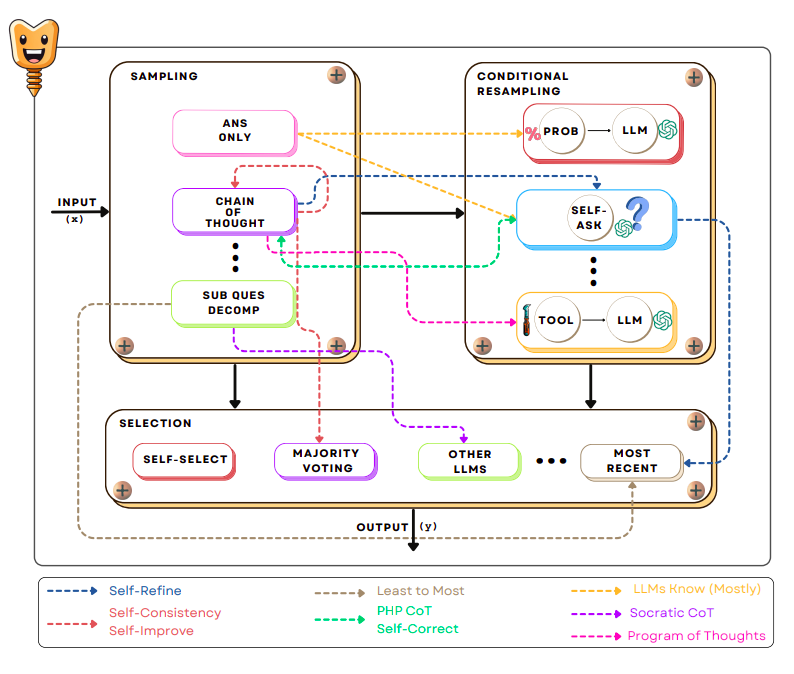
Figure 2 presents a high-level picture of the modular SCREWS system for reasoning about revisions. The three substantial boxes (or “modules”) each contain quite a few selections (or “submodules”). Many previous efforts, including Self-Refine, Least to Most, LLMs Know (Mostly), Self-Consistency, Self-Improve, PHP CoT, Self-Correct, Socratic CoT, Programme of Thoughts, and plenty of more, could also be seen as examples of the framework. (…) denotes additional sub-components which may be added to every module, including, but not limited to, cached memory or online seek for the Sampling module, a fine-tuned model or an external verifier for Conditional Resampling, and selection based on humans or an oracle for the Selection module.
Sampling’s first outputs are handed on to Conditional Resampling, which determines whether to create a revision based on the unique sample and does so if essential. The Selection module then chooses the most effective from all of the samples and revisions. Given the modular design of their framework, additional framework elements could be used to boost several newly suggested self-refining approaches. One example is the mix of their model-based selection technique and self-refinement method, which may improve overall performance. They use ChatGPT or GPT-4 to evaluate SCREWS on various reasoning tasks, including multi-hop query answering, arithmetic reasoning, and code debugging.
In comparison with the usual sample and resampling procedures, their suggested solutions produce significant improvements (10–15%). They show the worth of heterogeneous resampling, showing how it could influence the model’s logic and substantially improve the baselines at a really low total cost. In addition they explain the importance of a model-based selection approach, an important element of up to date LLMs that allows the model to revert to earlier, more certain outputs.
Try the Paper. All Credit For This Research Goes To the Researchers on This Project. Also, don’t forget to hitch our 31k+ ML SubReddit, 40k+ Facebook Community, Discord Channel, and Email Newsletter, where we share the most recent AI research news, cool AI projects, and more.
For those who like our work, you’ll love our newsletter..

Aneesh Tickoo is a consulting intern at MarktechPost. He’s currently pursuing his undergraduate degree in Data Science and Artificial Intelligence from the Indian Institute of Technology(IIT), Bhilai. He spends most of his time working on projects geared toward harnessing the ability of machine learning. His research interest is image processing and is obsessed with constructing solutions around it. He loves to attach with people and collaborate on interesting projects.
