
For big scale Generative AI application to work well, it needs good system to handle lots of data. One such essential system is the vector database. This database is special since it deals with many sorts of data like text, sound, pictures, and videos in a number/vector form.
What are Vector Databases?
Vector database is a specialized storage system designed to handle high-dimensional vectors efficiently. These vectors, which may be regarded as points in a multi-dimensional space, often represent embeddings or compressed representations of more complex data like images, text, or sound. Vector databases allow for rapid similarity searches amongst these vectors, enabling quick retrieval of probably the most similar items from an enormous dataset.
Traditional Databases vs. Vector Databases
Vector Databases:
- Handles High-Dimensional Data: Vector databases are designed to administer and store data in high-dimensional spaces. This is especially useful for applications like machine learning, where data points (comparable to images or text) may be represented as vectors in multi-dimensional spaces.
- Optimized for Similarity Search: One standout features of vector databases is their ability to perform similarity searches. As a substitute of querying data based on exact matches, these databases allow users to retrieve data that’s “similar” to a given query, making them invaluable for tasks like image or text retrieval.
- Scalable for Large Datasets: As AI and machine learning applications proceed to grow, so does the quantity of information they process. Vector databases are built to scale, ensuring that they will handle vast amounts of information without compromising on performance.
Traditional Databases:
- Structured Data Storage: Traditional databases, like relational databases, are designed to store structured data. This implies data is organized into predefined tables, rows, and columns, ensuring data integrity and consistency.
- Optimized for CRUD Operations: Traditional databases are primarily optimized for CRUD operations. This implies they’re designed to efficiently create, read, update, and delete data entries, making them suitable for a wide selection of applications, from web services to enterprise software.
- Fixed Schema: One in every of the defining characteristics of many traditional databases is their fixed schema. Once the database structure is defined, making changes may be complex and time-consuming. This rigidity ensures data consistency but may be less flexible than the schema-less or dynamic schema nature of some modern databases.
Old databases struggle with embeddings. They can not handle their complexity. Vector databases solve this problem.
With vector databases, Generative AI application can do more things. It could find information based on meaning and remember things for a very long time.
Vector Database

High-Level Architecture of a Vector Database
The diagram shows the elemental workflow of a vector database. The method begins with raw data input, which undergoes preprocessing to scrub and standardize the information.
This data is then vectorized, converting it right into a format suitable for similarity searches and efficient storage. Once vectorized, the information is stored and indexed to facilitate rapid and accurate retrieval. When a question is made, the database processes it, leveraging the indexing to efficiently retrieve probably the most relevant data.
Generative AI and The Need for Vector Databases
Generative AI often involves embeddings. Take, for example, word embeddings in natural language processing (NLP). Words or sentences are transformed into vectors that capture semantic meaning. When generating human-like text, models have to rapidly compare and retrieve relevant embeddings, ensuring that the generated text maintains contextual meanings.
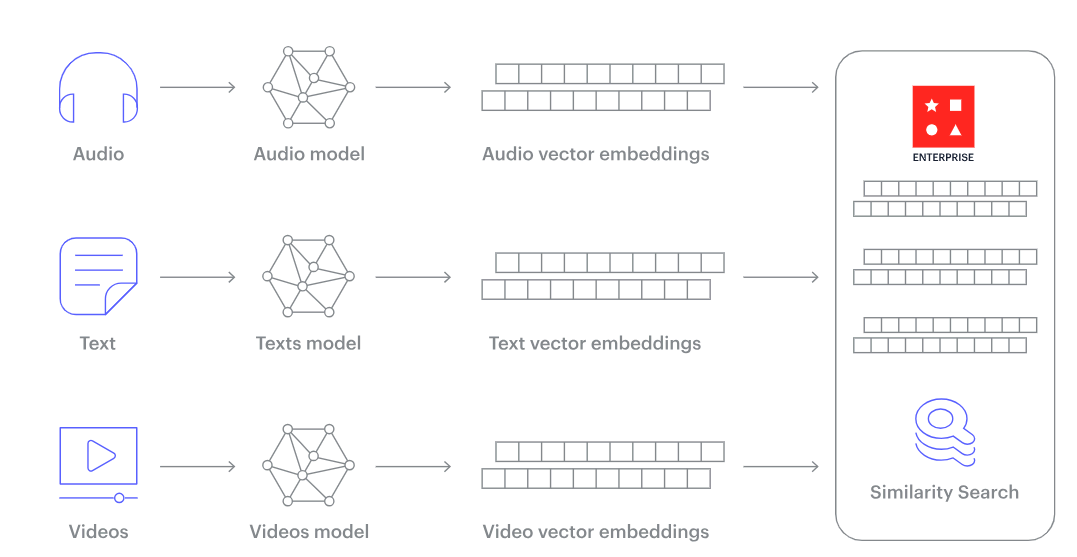
Vector Database redis db
Similarly, in image or sound generation, embeddings play a vital role in encoding patterns and features. For these models to operate optimally, they require a database that permits for instantaneous retrieval of comparable vectors, making vector databases a vital part of the generative AI puzzle.
Creating embeddings for natural language often involves using pre-trained models comparable to OpenAI’s GPT, BERT.
Pre-trained Models:
- GPT-3 and GPT-4: OpenAI’s GPT-3 (Generative Pre-trained Transformer 3) has been a monumental model within the NLP community with 175 billion parameters. Following it, GPT-4, with a good larger variety of parameters, continues to push the boundaries in generating high-quality embeddings. These models are trained on diverse datasets, enabling them to create embeddings that capture a big selection of linguistic nuances.
- BERT and its Variants: BERT (Bidirectional Encoder Representations from Transformers) by Google, is one other significant model that has seen various updates and iterations like RoBERTa, and DistillBERT. BERT’s bidirectional training, which reads text in each directions, is especially adept at understanding the context surrounding a word.
- ELECTRA: A newer model that’s efficient and performs at par with much larger models like GPT-3 and BERT while requiring less computing resources. ELECTRA discriminates between real and faux data during pre-training, which helps in generating more refined embeddings.
Growing Funding for Vector Database Newcomers
With AI’s rising popularity, many corporations are putting extra money into vector databases to make their algorithms higher and faster. This may be seen with the recent investments in vector database startups like Pinecone, Chroma DB, and Weviate.
Large cooperation like Microsoft have their very own tools too. For instance, Azure Cognitive Search lets businesses create AI tools using vector databases.
Oracle also recently announced recent features for its Database 23c, introducing an Integrated Vector Database. Named “AI Vector Search,” it would have a brand new data type, indexes, and search tools to store and search through data like documents and pictures using vectors. It supports Retrieval Augmented Generation (RAG), which mixes large language models with business data for higher answers to language questions without sharing private data.
Primary Considerations of Vector Databases
- Indexing: Given the high-dimensionality of vectors, traditional indexing methods don’t cut it. Vector databases uses techniques like Hierarchical Navigable Small World (HNSW) graphs or Annoy trees, allowing for efficient partitioning of the vector space and rapid nearest-neighbor searches.

Annoy tree (Source)
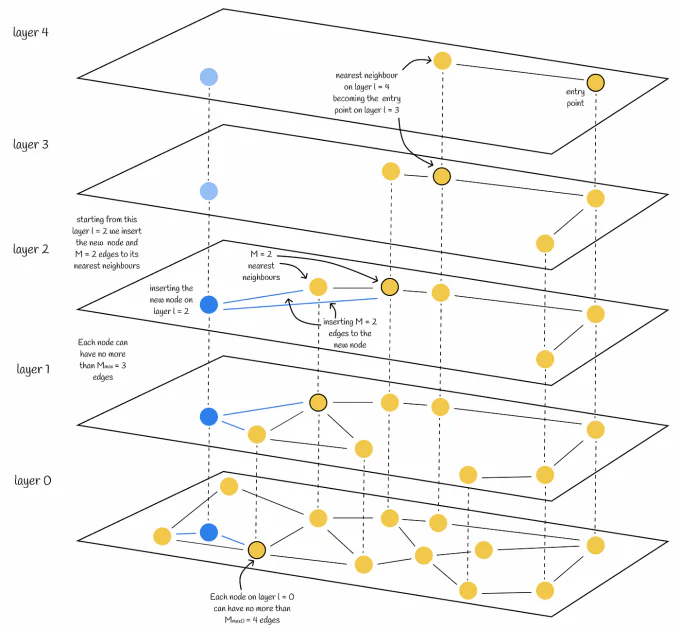
Hierarchical Navigable Small World (HNSW) graphs (Source)
- Distance Metrics: The effectiveness of a similarity search hinges on the chosen distance metric. Common metrics include Euclidean distance and cosine similarity, each catering to several types of vector distributions.
- Scalability: As datasets grow, so does the challenge of maintaining fast retrieval times. Distributed systems, GPU acceleration, and optimized memory management are some ways vector databases tackle scalability.
Vector Databases and Generative AI: Speed and Creativity
The actual magic unfolds when vector databases work in tandem with generative AI models. Here’s why:
- Enhanced Coherence: By enabling rapid retrieval of comparable vectors, generative models can maintain higher context, resulting in more coherent and contextually appropriate outputs.
- Iterative Refinement: Generative models can use vector databases to match generated outputs against a repository of ‘good’ embeddings, allowing them to refine their outputs in real-time.
- Diverse Outputs: With the flexibility to explore various regions of the vector space, generative models can produce a greater diversity of outputs, enriching their creative potential.
The Future: Potential Implications and Opportunities
With the convergence of generative AI and vector databases, several exciting possibilities emerge:
- Personalized Content Creation: Imagine AI models tailoring content, be it text, images, or music, based on individual user embeddings stored in vector databases. The era of hyper-personalized content may not be far off.
- Advanced Data Retrieval: Beyond generative AI, vector databases can revolutionize data retrieval in domains like e-commerce, where product recommendations may very well be based on deep embeddings moderately than superficial tags.
The AI world is changing fast. It’s touching many industries, bringing good things and recent problems. AI now needs good data processing. It’s because of massive language models, generative AI, and semantic search.