
A brand new tool lets artists add invisible changes to the pixels of their art before they upload it online in order that if it’s scraped into an AI training set, it will possibly cause the resulting model to interrupt in chaotic and unpredictable ways.
The tool, called Nightshade, is meant as a technique to fight back against AI corporations that use artists’ work to coach their models without the creator’s permission. Using it to “poison” this training data could damage future iterations of image-generating AI models, similar to DALL-E, Midjourney, and Stable Diffusion, by rendering a few of their outputs useless—dogs turn into cats, cars turn into cows, and so forth. MIT Technology Review got an exclusive preview of the research, which has been submitted for peer review at computer security conference Usenix.
AI corporations similar to OpenAI, Meta, Google, and Stability AI are facing a slew of lawsuits from artists who claim that their copyrighted material and private information was scraped without consent or compensation. Ben Zhao, a professor on the University of Chicago, who led the team that created Nightshade, says the hope is that it would help tip the facility balance back from AI corporations towards artists, by creating a strong deterrent against disrespecting artists’ copyright and mental property. Meta, Google, Stability AI, and OpenAI didn’t reply to MIT Technology Review’s request for comment on how they may respond.
Zhao’s team also developed Glaze, a tool that enables artists to “mask” their very own personal style to stop it from being scraped by AI corporations. It really works in an identical technique to Nightshade: by changing the pixels of images in subtle ways which might be invisible to the human eye but manipulate machine-learning models to interpret the image as something different from what it actually shows.
The team intends to integrate Nightshade into Glaze, and artists can select whether or not they need to use the data-poisoning tool or not. The team can be making Nightshade open source, which might allow others to tinker with it and make their very own versions. The more people use it and make their very own versions of it, the more powerful the tool becomes, Zhao says. The information sets for giant AI models can consist of billions of images, so the more poisoned images could be scraped into the model, the more damage the technique will cause.
A targeted attack
Nightshade exploits a security vulnerability in generative AI models, one arising from the undeniable fact that they’re trained on vast amounts of information—on this case, images which were hoovered from the web. Nightshade messes with those images.
Artists who need to upload their work online but don’t want their images to be scraped by AI corporations can upload them to Glaze and decide to mask it with an art style different from theirs. They’ll then also opt to make use of Nightshade. Once AI developers scrape the web to get more data to tweak an existing AI model or construct a brand new one, these poisoned samples make their way into the model’s data set and cause it to malfunction.
Poisoned data samples can manipulate models into learning, for instance, that images of hats are cakes, and pictures of purses are toasters. The poisoned data may be very difficult to remove, because it requires tech corporations to painstakingly find and delete each corrupted sample.
The researchers tested the attack on Stable Diffusion’s latest models and on an AI model they trained themselves from scratch. After they fed Stable Diffusion just 50 poisoned images of dogs after which prompted it to create images of dogs itself, the output began looking weird—creatures with too many limbs and cartoonish faces. With 300 poisoned samples, an attacker can manipulate Stable Diffusion to generate images of dogs to seem like cats.
Generative AI models are excellent at making connections between words, which helps the poison spread. Nightshade infects not only the word “dog” but all similar concepts, similar to “puppy,” “husky,” and “wolf.” The poison attack also works on tangentially related images. For instance, if the model scraped a poisoned image for the prompt “fantasy art,” the prompts “dragon” and “a castle in ” would similarly be manipulated into something else.
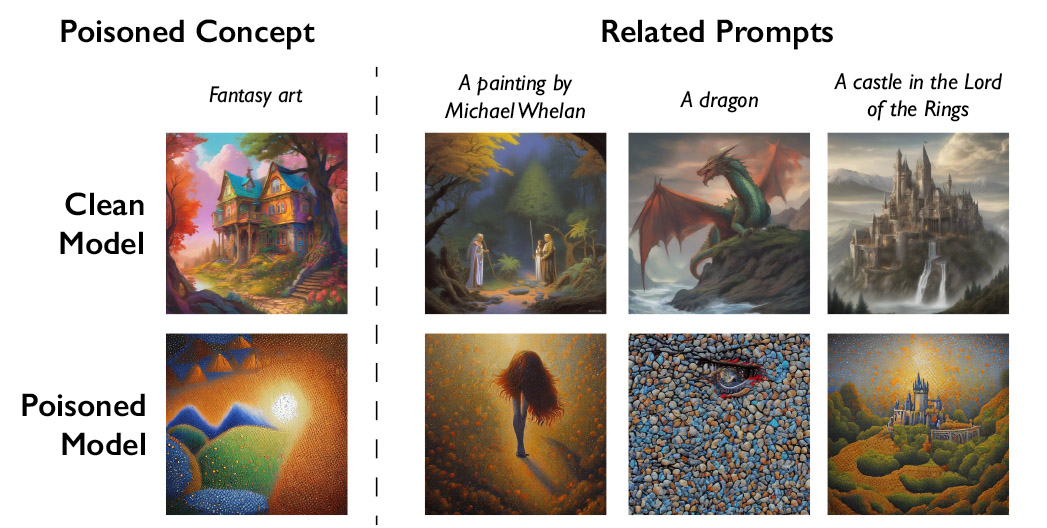
Zhao admits there’s a risk that individuals might abuse the info poisoning technique for malicious uses. Nevertheless, he says attackers would want hundreds of poisoned samples to inflict real damage on larger, more powerful models, as they’re trained on billions of information samples.
“We don’t yet know of strong defenses against these attacks. We haven’t yet seen poisoning attacks on modern [machine learning] models within the wild, nevertheless it could possibly be only a matter of time,” says Vitaly Shmatikov, a professor at Cornell University who studies AI model security and was not involved within the research. “The time to work on defenses is now,” Shmatikov adds.
Gautam Kamath, an assistant professor on the University of Waterloo who researches data privacy and robustness in AI models and wasn’t involved within the study, says the work is “improbable.”
The research shows that vulnerabilities “don’t magically go away for these recent models, and in truth only turn into more serious,” Kamath says. “This is particularly true as these models turn into more powerful and other people place more trust in them, for the reason that stakes only rise over time.”
A robust deterrent
Junfeng Yang, a pc science professor at Columbia University, who has studied the safety of deep-learning systems and wasn’t involved within the work, says Nightshade could have a big effect if it makes AI corporations respect artists’ rights more—for instance, by being more willing to pay out royalties.
AI corporations which have developed generative text-to-image models, similar to Stability AI and OpenAI, have offered to let artists opt out of getting their images used to coach future versions of the models. But artists say this will not be enough. Eva Toorenent, an illustrator and artist who has used Glaze, says opt-out policies require artists to leap through hoops and still leave tech corporations with all the facility.
Toorenent hopes Nightshade will change the established order.
“It’ll make [AI companies] think twice, because they’ve the potential for destroying their entire model by taking our work without our consent,” she says.
Autumn Beverly, one other artist, says tools like Nightshade and Glaze have given her the arrogance to post her work online again. She previously removed it from the web after discovering it had been scraped without her consent into the favored LAION image database.
“I’m just really grateful that we now have a tool that will help return the facility back to the artists for their very own work,” she says.