
Transformer has change into the fundamental model that adheres to the scaling rule after achieving great success in natural language processing and computer vision. Time series forecasting is seeing the emergence of a Transformer, which is very able to extracting multi-level representations from sequences and representing pairwise relationships, due to its enormous success in other broad disciplines. The validity of transformer-based forecasts, which often embed several variates of the identical timestamp into indistinguishable channels and focus emphasis on these temporal tokens to capture temporal relationships, has recently come under scrutiny, though, from academics.
Transformer has change into the fundamental model that adheres to the scaling rule after achieving great success in natural language processing and computer vision. Time series forecasting is seeing the emergence of a Transformer, which is very able to extracting multi-level representations from sequences and representing pairwise relationships, due to its enormous success in other broad disciplines. The validity of transformer-based forecasts, which often embed several variates of the identical timestamp into indistinguishable channels and focus emphasis on these temporal tokens to capture temporal relationships, has recently come under scrutiny, though, from academics.
They observe that multivariate time series forecasting may should be a greater fit for the Transformer-based forecasters’ current structure. Figure 2’s left panel makes note of the proven fact that points from the identical time step that essentially reflect radically diverse physical meanings captured by contradictory measurements are combined right into a single token with multivariate correlations erased. Moreover, due to real world’s highly local receptive field and misaligned timestamps of multiple time points, the token created by a single time step may find it difficult to reveal useful information. Moreover, within the temporal dimension, permutation-invariant attention mechanisms are inappropriately used despite the fact that sequence order might need a major impact on series variations.
In consequence, Transformer loses its ability to explain multivariate correlations and capture crucial series representations, which restricts its application and generalization capabilities on various time series data. They use an inverted perspective on time series and embed the whole time series of every variate individually right into a token, the intense example of Patching that enlarges the local receptive field in response to the irrationality of embedding multivariate points of every time step as a token. The embedded token inverts and aggregates global representations of series, which could also be higher utilized by booming attention mechanisms for multivariate correlating and more variate-centric.
Figure 1: iTransformer’s performance. TimesNet is used to report average results (MSE).
In the intervening time, the feed-forward network could also be trained to amass sufficiently well-generalized representations for various variates which might be encoded from any lookback series after which decoded to forecast subsequent series. For the explanations outlined above, they think that Transformer is being utilized incorrectly reasonably than being ineffectual for time series forecasting. They go over Transformer’s architecture again on this study and promote iTransformer because the essential framework for time series forecasting. In technical terms, they use the feed-forward network for series encoding, adopt the eye for multivariate correlations, and embed every time series as variate tokens. When it comes to experimentation, the suggested iTransformer unexpectedly addresses the shortcomings of Transformer-based forecasters while achieving state-of-the-art performance on the real-world forecasting benchmarks in Figure 1.
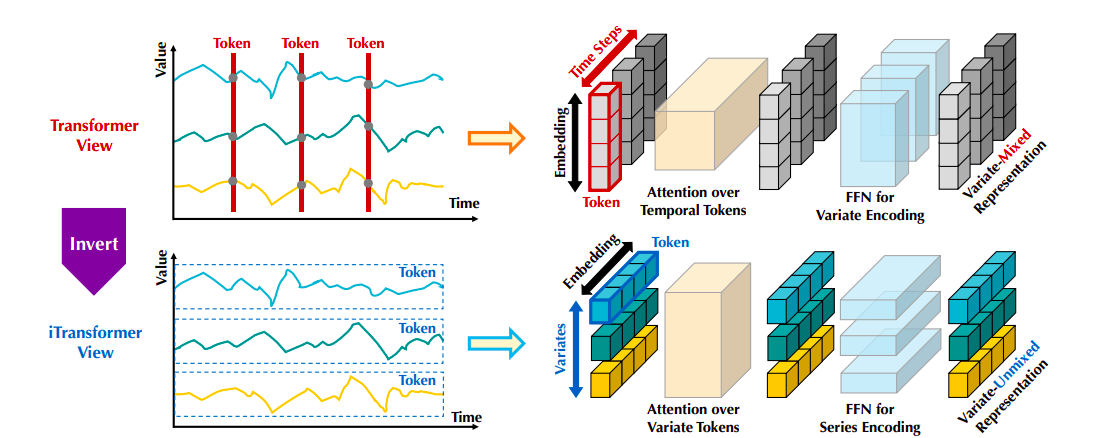
Figure 2: A comparison of the suggested iTransformer (bottom) and the vanilla Transformer (top).In contrast to Transformer, which embeds every time step to the temporal token, iTransformer embeds the entire series independently to the variate token. In consequence, the feed-forward network encodes series representations, and the eye mechanism can show multivariate correlations.
Three things they’ve contributed are as follows:
• Researchers from Tsinghua University suggest iTransformer, which views independent time series as tokens to capture multivariate correlations by self-attention. It uses layer normalization and feed-forward network modules to learn higher series-global representations for time series forecasting.
• They reflect on the Transformer architecture and refine the competent capability of native Transformer components on time series is underexplored.
• On real-world predicting benchmarks, iTransformer consistently obtains state-of-the-art ends in experiments. Their thorough evaluation of the inverted modules and architectural decisions points to a possible path for advancing Transformer-based predictors in the long run.
Try the Paper and Github. All credit for this research goes to the researchers of this project. Also, don’t forget to affix our 32k+ ML SubReddit, 41k+ Facebook Community, Discord Channel, and Email Newsletter, where we share the most recent AI research news, cool AI projects, and more.
When you like our work, you’ll love our newsletter..
We’re also on Telegram and WhatsApp.

Aneesh Tickoo is a consulting intern at MarktechPost. He’s currently pursuing his undergraduate degree in Data Science and Artificial Intelligence from the Indian Institute of Technology(IIT), Bhilai. He spends most of his time working on projects aimed toward harnessing the ability of machine learning. His research interest is image processing and is obsessed with constructing solutions around it. He loves to attach with people and collaborate on interesting projects.