
Large Language Models (LLMs) have recently prolonged their reach beyond traditional natural language processing, demonstrating significant potential in tasks requiring multimodal information. Their integration with video perception abilities is especially noteworthy, a pivotal move in artificial intelligence. This research takes a large leap in exploring LLMs’ capabilities in video grounding (VG), a critical task in video evaluation that involves pinpointing specific video segments based on textual descriptions.
The core challenge in VG lies within the precision of temporal boundary localization. The duty demands accurately identifying the beginning and end times of video segments based on given textual queries. While LLMs have shown promise in various domains, their effectiveness in accurately performing VG tasks still must be explored. This gap in research is what the study seeks to handle, delving into the capabilities of LLMs on this nuanced task.
Traditional methods in VG have varied, from reinforcement learning techniques that adjust temporal windows to dense regression networks that estimate distances from video frames to the goal segment. These methods, nevertheless, rely heavily on specialized training datasets tailored for VG, limiting their applicability in additional generalized contexts. The novelty of this research lies in its departure from these conventional approaches, proposing a more versatile and comprehensive evaluation method.
The researcher from Tsinghua University introduced ‘LLM4VG’, a benchmark specifically designed to judge the performance of LLMs in VG tasks. This benchmark considers two primary strategies: the primary involves video LLMs trained directly on text-video datasets (VidLLMs), and the second combines conventional LLMs with pretrained visual models. These graphical models convert video content into textual descriptions, bridging the visual-textual information gap. This dual approach allows for a radical assessment of LLMs’ capabilities in understanding and processing video content.
A deeper dive into the methodology reveals the intricacies of the approach. In the primary strategy, VidLLMs directly process video content and VG task instructions, outputting predictions based on their training on text-video pairs. The second strategy is more complex, involving LLMs and visual description models. These models generate textual descriptions of video content integrated with VG task instructions through fastidiously designed prompts. These prompts are tailored to effectively mix the instruction of VG with the given visual description, thus enabling the LLMs to process and understand the video content in regards to the task.
The performance evaluation of those strategies brought forth some notable results. It was observed that VidLLMs, despite their direct training on video content, still lag significantly in achieving satisfactory VG performance. This finding underscores the need of incorporating more time-related video tasks of their training for a performance boost. Conversely, combining LLMs with visual models showed preliminary abilities in VG tasks. This strategy outperformed VidLLMs, suggesting a promising direction for future research. Nevertheless, the performance was primarily constrained by the constraints within the visual models and the design of the prompts. The study indicates that more refined graphical models, able to generating detailed and accurate video descriptions, could substantially enhance LLMs’ VG performance.
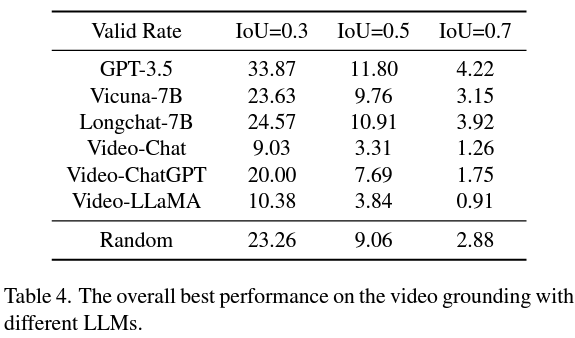
In conclusion, the research presents a groundbreaking evaluation of LLMs within the context of VG tasks, emphasizing the necessity for more sophisticated approaches in model training and prompt design. While current VidLLMs need more temporal understanding, integrating LLMs with visual models opens up recent possibilities, marking a crucial step forward in the sphere. The findings of this study not only make clear the present state of LLMs in VG tasks but in addition pave the best way for future advancements, potentially revolutionizing how video content is analyzed and understood.
Take a look at the Paper. All credit for this research goes to the researchers of this project. Also, don’t forget to hitch our 35k+ ML SubReddit, 41k+ Facebook Community, Discord Channel, LinkedIn Group, and Email Newsletter, where we share the most recent AI research news, cool AI projects, and more.
Should you like our work, you’ll love our newsletter..

Muhammad Athar Ganaie, a consulting intern at MarktechPost, is a proponet of Efficient Deep Learning, with a give attention to Sparse Training. Pursuing an M.Sc. in Electrical Engineering, specializing in Software Engineering, he blends advanced technical knowledge with practical applications. His current endeavor is his thesis on “Improving Efficiency in Deep Reinforcement Learning,” showcasing his commitment to enhancing AI’s capabilities. Athar’s work stands on the intersection “Sparse Training in DNN’s” and “Deep Reinforcemnt Learning”.