
The combination and application of enormous language models (LLMs) in medicine and healthcare has been a subject of serious interest and development.
As noted within the Healthcare Information Management and Systems Society global conference and other notable events, corporations like Google are leading the charge in exploring the potential of generative AI inside healthcare. Their initiatives, corresponding to Med-PaLM 2, highlight the evolving landscape of AI-driven healthcare solutions, particularly in areas like diagnostics, patient care, and administrative efficiency.
Google’s Med-PaLM 2, a pioneering LLM within the healthcare domain, has demonstrated impressive capabilities, notably achieving an “expert” level in U.S. Medical Licensing Examination-style questions. This model, and others prefer it, promise to revolutionize the way in which healthcare professionals access and utilize information, potentially enhancing diagnostic accuracy and patient care efficiency.
Nevertheless, alongside these advancements, concerns in regards to the practicality and safety of those technologies in clinical settings have been raised. For example, the reliance on vast web data sources for model training, while helpful in some contexts, may not at all times be appropriate or reliable for medical purposes. As Nigam Shah, PhD, MBBS, Chief Data Scientist for Stanford Health Care, points out, the crucial inquiries to ask are in regards to the performance of those models in real-world medical settings and their actual impact on patient care and healthcare efficiency.
Dr. Shah’s perspective underscores the necessity for a more tailored approach to utilizing LLMs in medicine. As a substitute of general-purpose models trained on broad web data, he suggests a more focused strategy where models are trained on specific, relevant medical data. This approach resembles training a medical intern – providing them with specific tasks, supervising their performance, and step by step allowing for more autonomy as they exhibit competence.
In step with this, the event of Meditron by EPFL researchers presents an interesting advancement in the sector. Meditron, an open-source LLM specifically tailored for medical applications, represents a major step forward. Trained on curated medical data from reputable sources like PubMed and clinical guidelines, Meditron offers a more focused and potentially more reliable tool for medical practitioners. Its open-source nature not only promotes transparency and collaboration but additionally allows for continuous improvement and stress testing by the broader research community.
MEDITRON-70B-achieves-an-accuracy-of-70.2-on-USMLE-style-questions-in-the-MedQA-4-options-dataset
The event of tools like Meditron, Med-PaLM 2, and others reflects a growing recognition of the unique requirements of the healthcare sector in terms of AI applications. The emphasis on training these models on relevant, high-quality medical data, and ensuring their safety and reliability in clinical settings, could be very crucial.
Furthermore, the inclusion of diverse datasets, corresponding to those from humanitarian contexts just like the International Committee of the Red Cross, demonstrates a sensitivity to the numerous needs and challenges in global healthcare. This approach aligns with the broader mission of many AI research centers, which aim to create AI tools that aren’t only technologically advanced but additionally socially responsible and helpful.
The paper titled “Large language models encode clinical knowledge” recently published in Nature, explores how large language models (LLMs) could be effectively utilized in clinical settings. The research presents groundbreaking insights and methodologies, shedding light on the capabilities and limitations of LLMs within the medical domain.
The medical domain is characterised by its complexity, with an unlimited array of symptoms, diseases, and coverings which might be continually evolving. LLMs must not only understand this complexity but additionally sustain with the newest medical knowledge and guidelines.
The core of this research revolves around a newly curated benchmark called MultiMedQA. This benchmark amalgamates six existing medical question-answering datasets with a brand new dataset, HealthSearchQA, which comprises medical questions ceaselessly searched online. This comprehensive approach goals to guage LLMs across various dimensions, including factuality, comprehension, reasoning, possible harm, and bias, thereby addressing the restrictions of previous automated evaluations that relied on limited benchmarks.
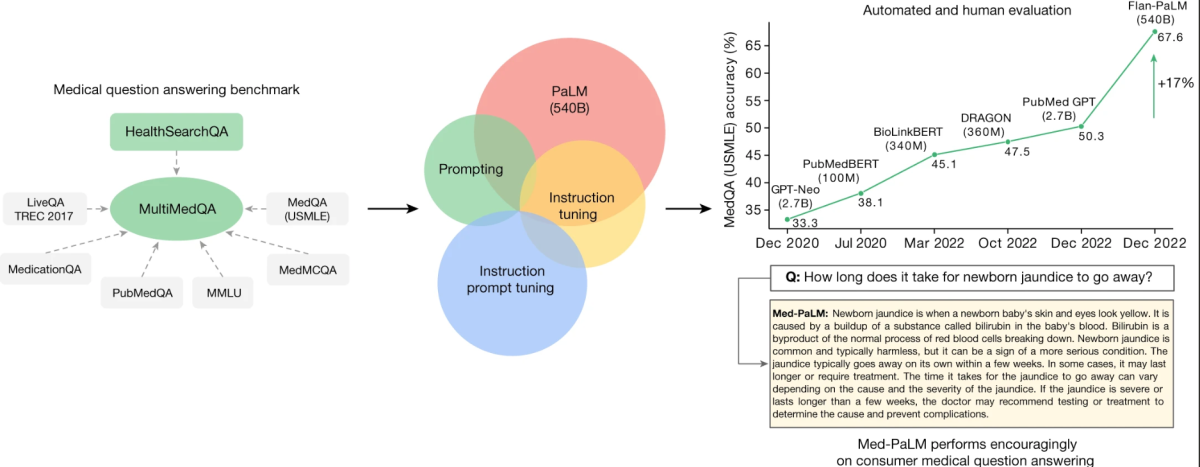
MultiMedQA, a benchmark for answering medical questions spanning medical exam
Key to the study is the evaluation of the Pathways Language Model (PaLM), a 540-billion parameter LLM, and its instruction-tuned variant, Flan-PaLM, on the MultiMedQA. Remarkably, Flan-PaLM achieves state-of-the-art accuracy on all of the multiple-choice datasets inside MultiMedQA, including a 67.6% accuracy on MedQA, which comprises US Medical Licensing Exam-style questions. This performance marks a major improvement over previous models, surpassing the prior state-of-the-art by greater than 17%.
MedQA
Format: query and answer (Q + A), multiple alternative, open domain.
Example query: A 65-year-old man with hypertension involves the physician for a routine health maintenance examination. Current medications include atenolol, lisinopril, and atorvastatin. His pulse is 86 min−1, respirations are 18 min−1, and blood pressure is 145/95 mmHg. Cardiac examination reveals end diastolic murmur. Which of the next is the almost certainly reason behind this physical examination?
Answers (correct answer in daring): (A) Decreased compliance of the left ventricle, (B) Myxomatous degeneration of the mitral valve (C) Inflammation of the pericardium (D) Dilation of the aortic root (E) Thickening of the mitral valve leaflets.
The study also identifies critical gaps within the model’s performance, especially in answering consumer medical questions. To deal with these issues, the researchers introduce a technique generally known as instruction prompt tuning. This method efficiently aligns LLMs to recent domains using a couple of exemplars, leading to the creation of Med-PaLM. The Med-PaLM model, though it performs encouragingly and shows improvement in comprehension, knowledge recall, and reasoning, still falls short in comparison with clinicians.
A notable aspect of this research is the detailed human evaluation framework. This framework assesses the models’ answers for agreement with scientific consensus and potential harmful outcomes. For example, while only 61.9% of Flan-PaLM’s long-form answers aligned with scientific consensus, this figure rose to 92.6% for Med-PaLM, comparable to clinician-generated answers. Similarly, the potential for harmful outcomes was significantly reduced in Med-PaLM’s responses in comparison with Flan-PaLM.
The human evaluation of Med-PaLM’s responses highlighted its proficiency in several areas, aligning closely with clinician-generated answers. This underscores Med-PaLM’s potential as a supportive tool in clinical settings.
The research discussed above delves into the intricacies of enhancing Large Language Models (LLMs) for medical applications. The techniques and observations from this study could be generalized to enhance LLM capabilities across various domains. Let’s explore these key features:
Instruction Tuning Improves Performance
- Generalized Application: Instruction tuning, which involves fine-tuning LLMs with specific instructions or guidelines, has shown to significantly improve performance across various domains. This method could possibly be applied to other fields corresponding to legal, financial, or educational domains to reinforce the accuracy and relevance of LLM outputs.
Scaling Model Size
- Broader Implications: The remark that scaling the model size improves performance is just not limited to medical query answering. Larger models, with more parameters, have the capability to process and generate more nuanced and complicated responses. This scaling could be helpful in domains like customer support, creative writing, and technical support, where nuanced understanding and response generation are crucial.
Chain of Thought (COT) Prompting
- Diverse Domains Utilization: The usage of COT prompting, although not at all times improving performance in medical datasets, could be priceless in other domains where complex problem-solving is required. For example, in technical troubleshooting or complex decision-making scenarios, COT prompting can guide LLMs to process information step-by-step, resulting in more accurate and reasoned outputs.
Self-Consistency for Enhanced Accuracy
- Wider Applications: The strategy of self-consistency, where multiple outputs are generated and essentially the most consistent answer is chosen, can significantly enhance performance in various fields. In domains like finance or legal where accuracy is paramount, this method could be used to cross-verify the generated outputs for higher reliability.
Uncertainty and Selective Prediction
- Cross-Domain Relevance: Communicating uncertainty estimates is crucial in fields where misinformation can have serious consequences, like healthcare and law. Using LLMs’ ability to precise uncertainty and selectively defer predictions when confidence is low generally is a crucial tool in these domains to stop the dissemination of inaccurate information.
The true-world application of those models extends beyond answering questions. They could be used for patient education, assisting in diagnostic processes, and even in training medical students. Nevertheless, their deployment should be rigorously managed to avoid reliance on AI without proper human oversight.
As medical knowledge evolves, LLMs must also adapt and learn. This requires mechanisms for continuous learning and updating, ensuring that the models remain relevant and accurate over time.