
In partnership withDatabricks
As organizations recognize the transformational opportunity presented by generative AI, they need to consider deploy that technology across the enterprise within the context of their unique industry challenges, priorities, data types, applications, ecosystem partners, and governance requirements. Financial institutions, for instance, have to make sure that data and AI governance has the built-in intelligence to completely align with strict compliance and regulatory requirements. Media and entertainment (M&E) corporations seek to construct AI models to drive deeper product personalization. And manufacturers wish to use AI to make their web of things (IoT) data insights readily accessible to everyone from the information scientist to the shop floor employee.
Bringing breakthrough data intelligence to industries
-
Download the report
In any of those scenarios, the place to begin is access to all relevant data—of any type, from any source, in real time—governed comprehensively and shared across an industry ecosystem. When organizations can achieve this with the proper data and AI foundation, they’ve the beginnings of knowledge intelligence: the flexibility to grasp their data and break free from data silos that will block the most respected AI outcomes.
But true data intelligence is about greater than establishing the proper data foundation. Organizations are also wrestling with overcome dependence on highly technical staff and create frameworks for data privacy and organizational control when using generative AI. Specifically, they need to enable all employees to make use of natural language to glean actionable insight from the corporate’s own data; to leverage that data at scale to coach, construct, deploy, and tune their very own secure large language models (LLMs); and to infuse intelligence concerning the company’s data into every business process.
On this next frontier of knowledge intelligence, organizations will maximize value by democratizing AI while differentiating through their people, processes, and technology inside their industry context. Based on a worldwide, cross-industry survey of 600 technology leaders in addition to in-depth interviews with technology leaders, this report explores the foundations being built and leveraged across industries to democratize data and AI. Following are its key findings:
• Real-time access to data, streaming, and analytics are priorities in every industry. Due to the facility of data-driven decision-making and its potential for game-changing innovation, CIOs require seamless access to all of their data and the flexibility to glean insights from it in real time. Seventy-two percent of survey respondents say the flexibility to stream data in real time for evaluation and motion is “very vital” to their overall technology goals, while one other 20% imagine it’s “somewhat vital”—whether meaning enabling real-time recommendations in retail or identifying a next best motion in a critical health-care triage situation.
• All industries aim to unify their data and AI governance models. Aspirations for a single approach to governance of knowledge and AI assets are strong: 60% of survey respondents say a single approach to built-in governance for data and AI is “very vital,” and an extra 38% say it’s “somewhat vital,” suggesting that many organizations struggle with a fragmented or siloed data architecture. Every industry can have to attain this unified governance within the context of its own unique systems of record, data pipelines, and requirements for security and compliance.
• Industry data ecosystems and sharing across platforms will provide a brand new foundation for AI-led growth. In every industry, technology leaders see promise in technology-agnostic data sharing across an industry ecosystem, in support of AI models and core operations that can drive more accurate, relevant, and profitable outcomes. Technology teams at insurers and retailers, for instance, aim to ingest partner data to support real-time pricing and product offer decisions in online marketplaces, while manufacturers see data sharing as a vital capability for continuous supply chain optimization. Sixty-four percent of survey respondents say the flexibility to share live data across platforms is “very vital,” while an extra 31% say it’s “somewhat vital.” Moreover, 84% imagine a managed central marketplace for data sets, machine learning models, and notebooks may be very or somewhat vital.
• Preserving data and AI flexibility across clouds resonates with all verticals. Sixty-three percent of respondents across verticals imagine that the flexibility to leverage multiple cloud providers is not less than somewhat vital, while 70% feel the identical about open-source standards and technology. That is consistent with the finding that 56% of respondents see a single system to administer structured and unstructured data across business intelligence and AI as “very vital,” while an extra 40% see this as “somewhat vital.” Executives are prioritizing access to the entire organization’s data, of any type and from any source, securely and without compromise.
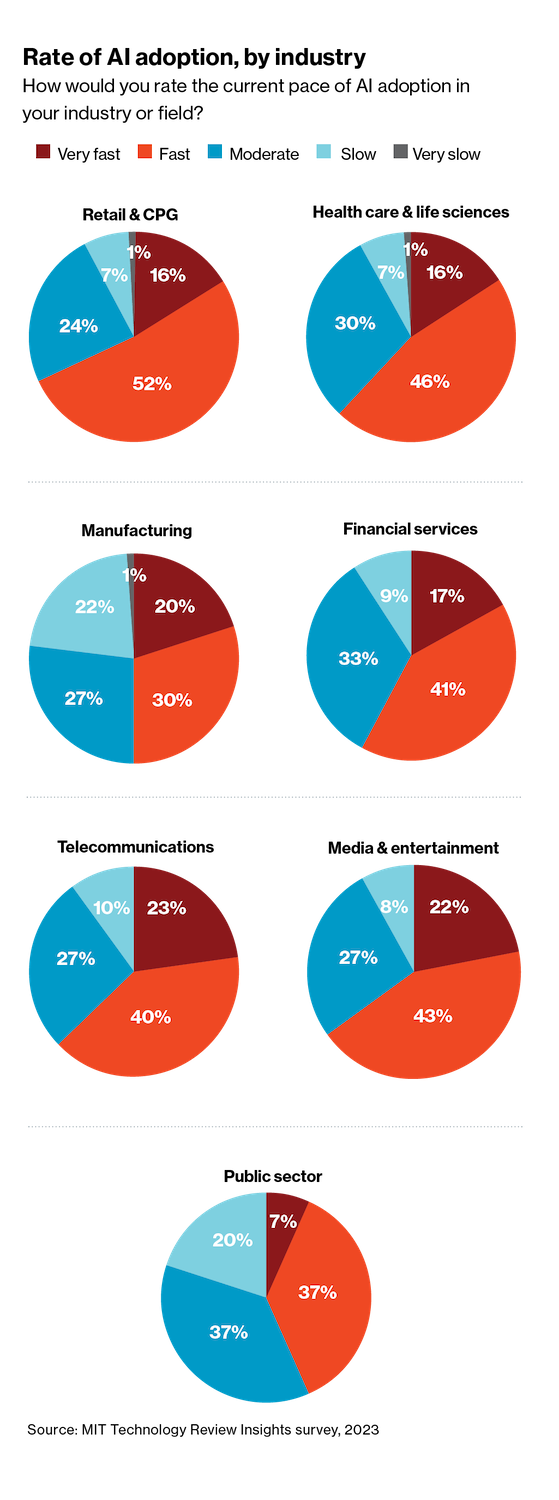
• Industry-specific requirements will drive the prioritization and pace by which generative AI use cases are adopted. Supply chain optimization is the highest-value generative AI use case for survey respondents in manufacturing, while it’s real-time data evaluation and insights for the general public sector, personalization and customer experience for M&E, and quality control for telecommunications. Generative AI adoption won’t be one-size-fits-all; each industry is taking its own strategy and approach. But in every case, value creation will depend upon access to data and AI permeating the enterprise’s ecosystem and AI being embedded into its services.
Maximizing value and scaling the impact of AI across people, processes, and technology is a standard goal across industries. But industry differences merit close attention for his or her implications on how intelligence is infused into the information and AI platforms. Whether or not it’s for the retail associate driving omnichannel sales, the health-care practitioner pursuing real-world evidence, the actuary analyzing risk and uncertainty, the factory employee diagnosing equipment, or the telecom field agent assessing network health, the language and scenarios AI will support vary significantly when democratized to the front lines of each industry.