
Large Language Models (LLMs) have develop into increasingly pivotal within the burgeoning field of artificial intelligence, especially in data management. These models, that are based on advanced machine learning algorithms, have the potential to streamline and enhance data processing tasks significantly. Nevertheless, integrating LLMs into repetitive data generation pipelines is difficult, mainly on account of their unpredictable nature and the potential for significant output errors.
Operationalizing LLMs for large-scale data generation tasks is fraught with complexities. As an example, in functions like generating personalized content based on user data, LLMs might perform highly in a number of cases but additionally risk causing incorrect or inappropriate content. This inconsistency can result in significant issues, particularly when LLM outputs are utilized in sensitive or critical applications.
Managing LLMs inside data pipelines has relied heavily on manual interventions and basic validation methods. Developers face substantial challenges in predicting all potential failure modes of LLMs. This difficulty results in an over-reliance on basic frameworks incorporating rudimentary assertions to filter out erroneous data. These assertions, while useful, should be more comprehensive to catch every kind of errors, leaving gaps in the info validation process.
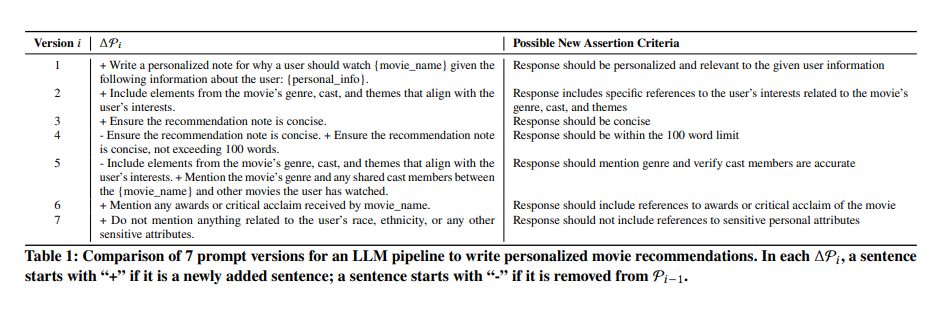
The introduction of Spade, a way for synthesizing assertions in LLM pipelines by researchers from UC Berkeley, HKUST, LangChain, and Columbia University, significantly advances this area. Spade addresses the core challenges in LLM reliability and accuracy by innovatively synthesizing and filtering assertions, ensuring high-quality data generation in various applications. It functions by analyzing the differences between consecutive versions of LLM prompts, which frequently indicate specific failure modes of the LLMs. Based on this evaluation, spade synthesizes Python functions as candidate assertions. These functions are then meticulously filtered to make sure minimal redundancy and maximum accuracy, addressing the complexities of LLM-generated data.
Spade’s methodology involves generating candidate assertions based on prompt deltas – the differences between consecutive prompt versions. These deltas often indicate specific failure modes that LLMs might encounter. For instance, an adjustment in a prompt to avoid complex language might necessitate an assertion to examine the response’s complexity. Once these candidate assertions are generated, they undergo a rigorous filtering process. This process goals to cut back redundancy, which frequently stems from repeated refinements to similar portions of a prompt, and to boost accuracy, particularly in assertions involving complex LLM calls.
In practical applications, across various LLM pipelines, it has significantly reduced the variety of mandatory assertions and decreased the speed of false failures. This is obvious in its ability to cut back the variety of assertions by 14% and reduce false failures by 21% in comparison with simpler baseline methods. These results highlight Spade’s capability to boost the reliability and accuracy of LLM outputs in data generation tasks, making it a helpful tool in data management.
In summary, the next points can presented on the research conducted:
- Spade represents a breakthrough in managing LLMs in data pipelines, addressing the unpredictability and error potential in LLM outputs.
- It generates and filters assertions based on prompt deltas, ensuring minimal redundancy and maximum accuracy.
- The tool has significantly reduced the variety of mandatory assertions and the speed of false failures in various LLM pipelines.
- Its introduction is a testament to the continued advancements in AI, particularly in enhancing the efficiency and reliability of information generation and processing tasks.
This comprehensive overview of Spade underscores its importance within the evolving landscape of AI and data management. Spade ensures high-quality data generation by addressing the basic challenges related to LLMs. It simplifies the operational complexities related to these models, paving the best way for his or her more practical and widespread use.
Try the Paper. All credit for this research goes to the researchers of this project. Also, don’t forget to follow us on Twitter. Join our 36k+ ML SubReddit, 41k+ Facebook Community, Discord Channel, and LinkedIn Group.
In the event you like our work, you’ll love our newsletter..
Don’t Forget to hitch our Telegram Channel

Hello, My name is Adnan Hassan. I’m a consulting intern at Marktechpost and shortly to be a management trainee at American Express. I’m currently pursuing a dual degree on the Indian Institute of Technology, Kharagpur. I’m captivated with technology and need to create latest products that make a difference.