
Recent advancements in conversational question-answering (QA) models have marked a big milestone. The introduction of enormous language models (LLMs) equivalent to GPT-4 has revolutionized how we approach conversational interactions and zero-shot response generation. These models have reshaped the landscape, enabling more user-friendly and intuitive interactions and pushing the boundaries of accuracy in automated responses with no need dataset-specific fine-tuning.
This research tackles the first challenge of enhancing zero-shot conversational QA accuracy in LLMs. Previously experimented methods, while somewhat effective, haven’t fully harnessed the potential of those powerful models. The research goals to refine these methods, achieving greater accuracy and setting latest benchmarks in conversational QA.
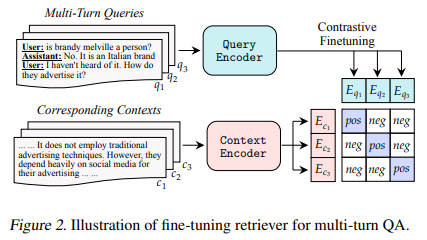
The present strategies in conversational QA primarily involve fine-tuning single-turn query retrievers on multi-turn QA datasets. While effective to a certain extent, these methods have room for improvement, especially in real-world applications. The research presents an modern approach that guarantees to deal with these limitations further and propel conversational QA models’ capabilities.
Researchers from NVIDIA have introduced ChatQA, a pioneering family of conversational QA models designed to succeed in and surpass the accuracy levels of GPT-4. ChatQA employs a novel two-stage instruction tuning method that significantly enhances zero-shot conversational QA results from LLMs. This method represents a significant breakthrough, substantially improving existing conversational models.
The methodology behind ChatQA is intricate and modern. The primary stage involves supervised fine-tuning (SFT) on a various range of datasets, which lays the muse for the model’s instruction-following capabilities. The second stage, context-enhanced instruction tuning, integrates contextualized QA datasets into the instruction tuning mix. This two-pronged approach ensures that the model follows instructions effectively and excels in contextualized or retrieval-augmented generation in conversational QA.
Considered one of the variants, ChatQA-70B, outperforms GPT-4 in average scores across ten conversational QA datasets, a feat achieved without counting on synthetic data from existing ChatGPT models. This outstanding performance is a testament to the efficacy of the two-stage instruction tuning method employed by ChatQA.
In conclusion, ChatQA represents a big breakthrough in conversational query answering. This research addresses the critical need for improved accuracy in zero-shot QA tasks and highlights the potential of advanced instruction tuning methods to boost the capabilities of enormous language models. The event of ChatQA could have far-reaching implications for the long run of conversational AI, paving the best way for more accurate, reliable, and user-friendly conversational models.
Take a look at the Paper. All credit for this research goes to the researchers of this project. Also, don’t forget to follow us on Twitter. Join our 36k+ ML SubReddit, 41k+ Facebook Community, Discord Channel, and LinkedIn Group.
In the event you like our work, you’ll love our newsletter..
Don’t Forget to hitch our Telegram Channel

Muhammad Athar Ganaie, a consulting intern at MarktechPost, is a proponet of Efficient Deep Learning, with a give attention to Sparse Training. Pursuing an M.Sc. in Electrical Engineering, specializing in Software Engineering, he blends advanced technical knowledge with practical applications. His current endeavor is his thesis on “Improving Efficiency in Deep Reinforcement Learning,” showcasing his commitment to enhancing AI’s capabilities. Athar’s work stands on the intersection “Sparse Training in DNN’s” and “Deep Reinforcemnt Learning”.
