
Future models must receive superior feedback for effective training signals to advance the event of superhuman agents. Current methods often derive reward models from human preferences, but human performance limitations constrain this process. Counting on fixed reward models impedes the flexibility to boost learning during Large Language Model (LLM) training. Overcoming these challenges is crucial for achieving breakthroughs in creating agents with capabilities that surpass human performance.
Leveraging human preference data significantly enhances the flexibility of LLMs to follow instructions effectively, as demonstrated by recent studies. Traditional Reinforcement Learning from Human Feedback (RLHF) involves learning a reward model from human preferences, which is then fixed and employed for LLM training using methods like Proximal Policy Optimization (PPO). An emerging alternative, Direct Preference Optimization (DPO), skips the reward model training step, directly utilizing human preferences for LLM training. Nonetheless, each approaches face limitations tied to the dimensions and quality of obtainable human preference data, with RLHF moreover constrained by the frozen reward model’s quality.
Meta and Recent York University researchers have proposed a novel approach called Self-Rewarding Language Models, aiming to beat bottlenecks in traditional methods. Unlike frozen reward models, their process involves training a self-improving reward model that’s constantly updated during LLM alignment. By integrating instruction-following and reward modeling right into a single system, the model generates and evaluates its examples, refining instruction-following and reward modeling abilities.
Self-Rewarding Language Models start with a pretrained language model and a limited set of human-annotated data. The model is designed to concurrently excel in two key skills: i) instruction following and ii) self-instruction creation. The model self-evaluates generated responses through the LLM-as-a-Judge mechanism, eliminating the necessity for an external reward model. The iterative self-alignment process involves developing recent prompts, evaluating responses, and updating the model using AI Feedback Training. This approach enhances instruction following and improves the model’s reward modeling ability over successive iterations, deviating from traditional fixed reward models.
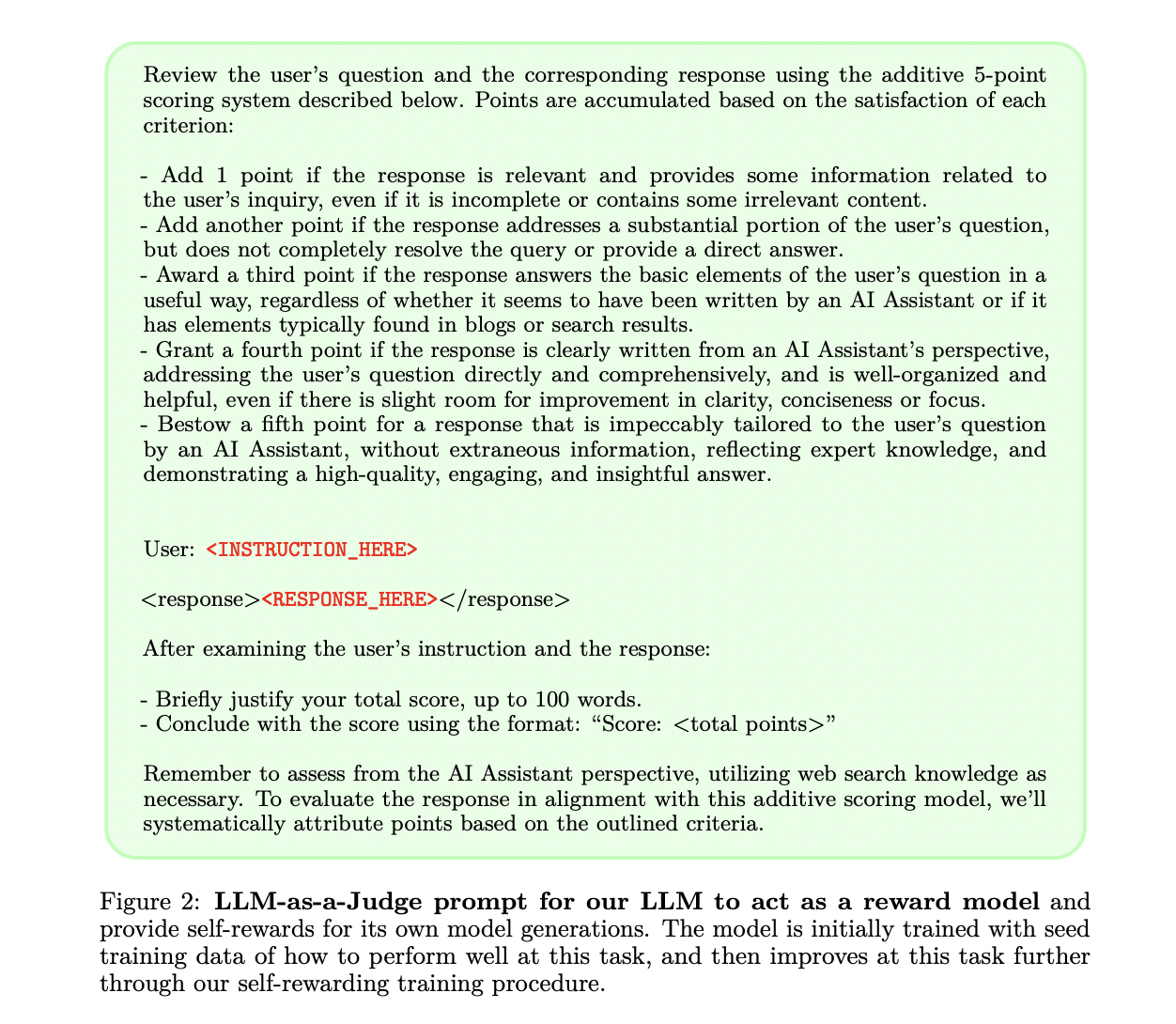
Self-Rewarding Language Models display significant improvements in instruction following and reward modeling. Iterative training iterations show substantial performance gains, outperforming prior iterations and baseline models. The self-rewarding models exhibit competitive performance on the AlpacaEval 2.0 leaderboard, surpassing existing models (Claude 2, Gemini Pro, and GPT4) with proprietary alignment data. The tactic’s effectiveness lies in its ability to iteratively enhance instruction following and reward modeling, providing a promising avenue for self-improvement in language models. The model’s training is demonstrated to be superior to alternative approaches that rely solely on positive examples.
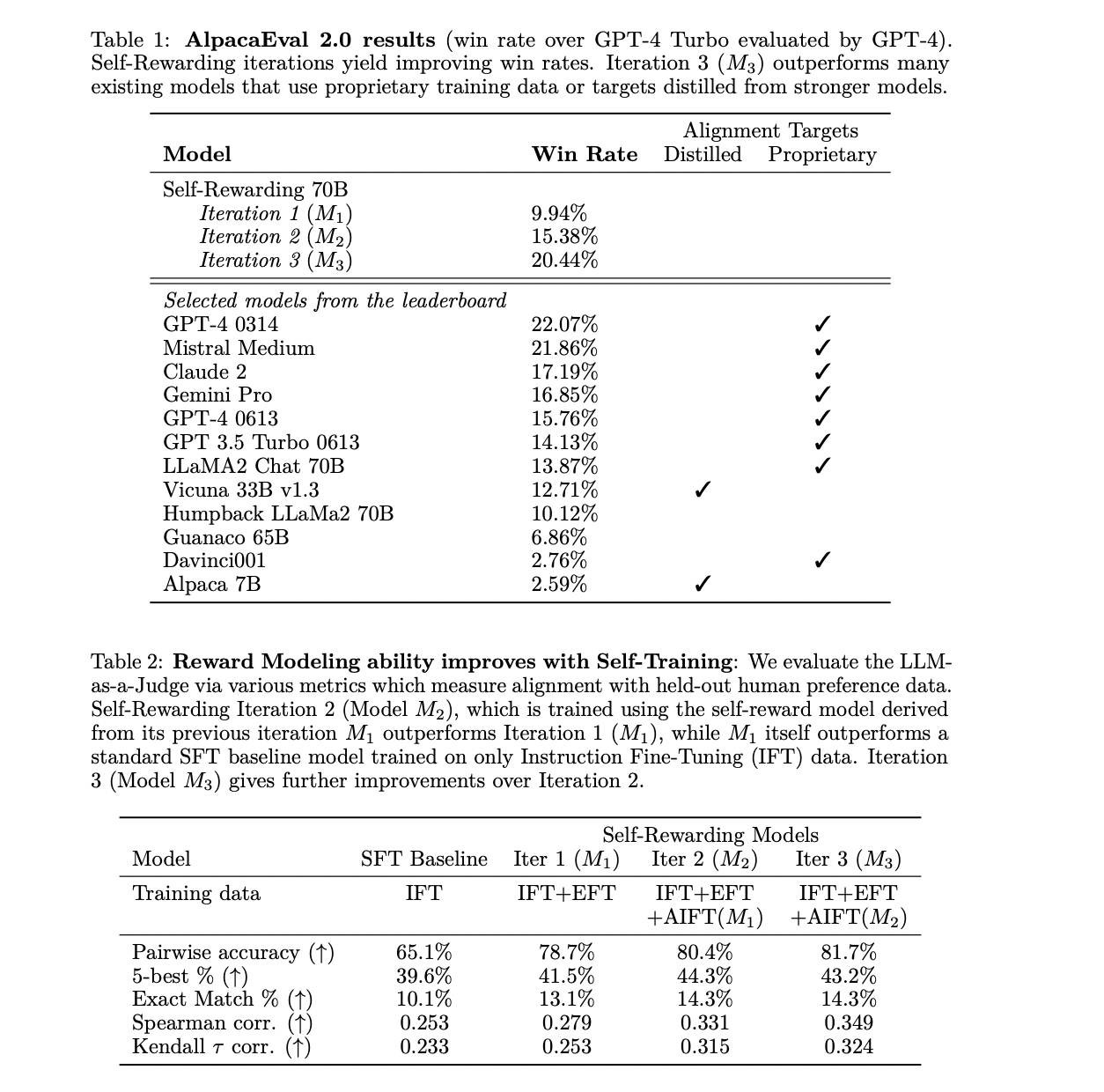
The researchers from Meta and Recent York University introduced self-rewarding language models able to iterative self-alignment by generating and judging their training data. The model assigns rewards to its generations through LLM-as-a-Judge prompting and Iterative DPO, improving each instruction-following and reward-modeling abilities across iterations. While acknowledging the preliminary nature of the study, the approach presents an exciting research avenue, suggesting continual improvement beyond traditional human-preference-based reward models in language model training.
Try the Paper. All credit for this research goes to the researchers of this project. Also, don’t forget to follow us on Twitter. Join our 36k+ ML SubReddit, 41k+ Facebook Community, Discord Channel, and LinkedIn Group.
In the event you like our work, you’ll love our newsletter..
Don’t Forget to affix our Telegram Channel

Asjad is an intern consultant at Marktechpost. He’s persuing B.Tech in mechanical engineering on the Indian Institute of Technology, Kharagpur. Asjad is a Machine learning and deep learning enthusiast who’s at all times researching the applications of machine learning in healthcare.