
One intriguing aspect of human cognition is the means of logical deduction, where conclusions are derived from a set of premises or facts. The logical structure dictates that the order of premises mustn’t influence the consequence of reasoning – a principle that holds in human cognitive processes to a big extent. Nevertheless, in AI, this problem arises in LLMs: their performance significantly varies with changes within the sequence of presented premises despite the logical conclusion remaining unchanged.
Existing research highlights that the premise order effect in LLMs is connected to failure modes reminiscent of the reversal curse, distractibility, and limited logical reasoning capability. Including irrelevant context in the issue statement results in a performance drop in LLMs, indicating distractibility. Because of this language models can somewhat understand permuted texts, but LLM reasoning performance is extremely sensitive to the ordering of premises.
Researchers from Google Deepmind and Stanford University have introduced a novel approach to determining the impact of premise ordering on LLM reasoning performance. By altering the sequence of premises in logical and mathematical reasoning tasks, the study systematically assesses the models’ ability to take care of accuracy. The findings are stark: a deviation from the optimal order can result in a performance drop of over 30%, highlighting a previously underexplored aspect of model sensitivity.
The premise order effect is measured by various the variety of rules required within the proof and the variety of distracting rules. The benchmark includes 27K problems with different premise orders and numbers of distracting rules. The R-GSM dataset was constructed to evaluate the effect of premise orders beyond logical reasoning in grade school math word problems. The R-GSM benchmark accommodates 220 pairs of problems with different orderings of problem statements. LLMs perform considerably worse on rewritten problems within the R-GSM benchmark. An example in R-GSM shows LLMs accurately solving the unique problem but failing on the rewritten one.
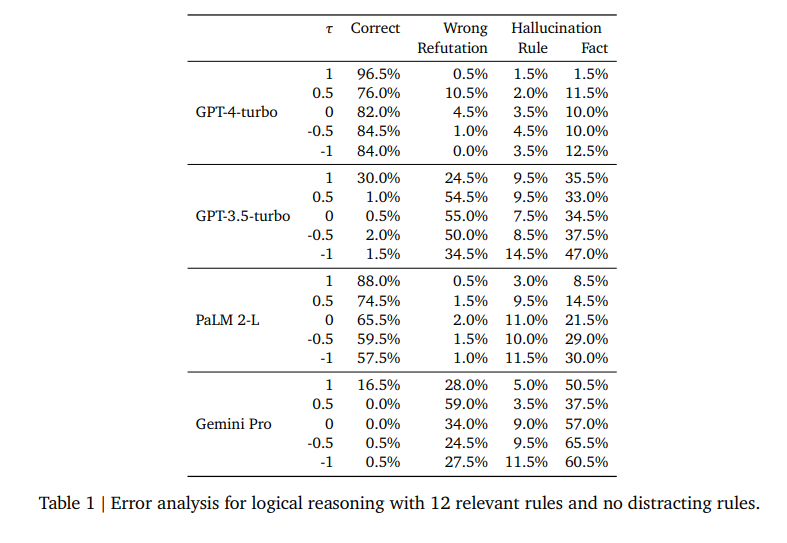
The study found that the performance of LLMs in reasoning tasks is significantly influenced by the order of presented premises, with a forward order yielding the very best results. Variations in preference for premise order were observed amongst different LLMs, notably with GPT-4-turbo and PaLM 2-L. The presence of distracting rules further impacts reasoning performance, exacerbating the challenge. The R-GSM dataset demonstrated a general decline in LLM accuracy, particularly with reordered problems, highlighting issues reminiscent of fact hallucination and errors arising from sequential processing and neglected temporal order.
In conclusion, the study critically examines the premise ordering effect, shedding light on an area of LLM performance that mirrors human cognitive biases yet deviates in its impact on reasoning accuracy. By addressing this limitation, the trail forward involves refining AI’s reasoning capabilities to higher align with human thought processes’ fluid and dynamic nature, ultimately resulting in more versatile and reliable models able to navigating the complexities of real-world reasoning tasks.
Try the Paper. All credit for this research goes to the researchers of this project. Also, don’t forget to follow us on Twitter and Google News. Join our 37k+ ML SubReddit, 41k+ Facebook Community, Discord Channel, and LinkedIn Group.
For those who like our work, you’ll love our newsletter..
Don’t Forget to affix our Telegram Channel

Nikhil is an intern consultant at Marktechpost. He’s pursuing an integrated dual degree in Materials on the Indian Institute of Technology, Kharagpur. Nikhil is an AI/ML enthusiast who’s all the time researching applications in fields like biomaterials and biomedical science. With a powerful background in Material Science, he’s exploring latest advancements and creating opportunities to contribute.