
“At Microsoft, we are saying we wish to empower the complete planet, right? And greater than half the world’s population uses languages aside from English.”
Bali says that AI has greatly sped up the technique of language preservation and its use in large language models (LLMs). This is helpful in creating online and AI tools, but in addition for preserving rare or dying languages.
“Now we will create these copilot sorts of things really quickly,” she says. “Previously once we were talking about language preservation, we were talking about efforts that took place over many years, literally. … All of that may now be shortened to months.”
Karya, which says it’s on pace to interact with greater than 100,000 employees by the tip of 2024, seeks participants who need work and education probably the most – often women in rural areas. Along with a premium wage, it offers training and different kinds of support when the work is completed.
‘Technology can really, really help amplify people’s desires’
Chopra grew up in a “basti” – a casual settlement – in Delhi and says that the inequities he witnessed growing up had a profound effect on his sense of purpose while studying computer science with a concentrate on AI at Stanford University in California.
“Once I moved back to India, the very first thing I spotted was, in all places I went, people had the intent or the desire to get out of poverty, everyone works really hard, everyone has aspiration,” he says. “They usually have the capability to learn latest skills. And if those two things exist, technology can really, really help amplify people’s desires, to make something of themselves.”
The work Bokale did over the course of 11 days was a part of a pilot project to check whether the work of inputting data might be combined with the educational of useful information. While earning what for them was a considerable amount of cash, they’d even be learning in regards to the financial tools they should make the most effective use of it.
The fabric was presented as a serialized story about two sisters, and it was this story that the employees read aloud into their smartphones to capture the sounds and rhythms of spoken Marathi. “We actually enjoyed the story,” Bokale says, “And in that story, there have been common people who find themselves working hard every single day. The cash they earned can be easily spent, there have been no savings. Briefly, the query was the way to save.”
Safiya Husain, Karya’s chief impact officer, said that the story format proved successful, and that most of the participants read the story out loud to their families and friends.
“They’d say, ‘I’m going to do that work and skim the story to you,” Husain says. “And they’d actually get excited and wonder, ‘Oh, what is going on next? Will she get her loan? Or will she have the funds for to pay for the marriage?’”
She says that by combining work with education, Karya was attempting to treat its employees with respect and create outcomes beyond income which might be meaningful. “We were paying people for his or her time, and we were saying what they were doing was helpful,” she says. “It wasn’t just, here’s a lesson to learn in your spare time.”
Husain says she hopes that eventually most of the Karya employees will join the organization in numerous roles, working as organizers and native administrators. In the massive picture, she says, the aim is to place technology to work for everybody.
“Once we’re collecting data in these languages like Marathi, we’re attempting to make sure that that these communities and these populations, which have tens of millions and tens of millions of speakers, should not being left behind within the technology revolution,” she says.
Engaging whole communities within the project
Kalika Bali, the Microsoft researcher, says considered one of the keys to the success of Karya is that it strives to interact whole communities within the project. Most of Karya’s employees are women, and she or he says they’ve more “circles of trust” to cross than men.
“The boys only must ask two things: will this work for me, and can I receives a commission?” she says. “Women need to ask; will my family accept it? Will this bring a nasty name to my family and myself by doing this? Is that this going to harm me not directly? Only then does it come to the platform and the cash.”
“The advantage with Karya is that it has created a number of trust on the bottom. They’re really engaged with the communities they’re in,” she says.
In her neighborhood in Pune, Bokale is a well known figure who’s universally often known as Baby Tai, tai meaning “elder sister.” She runs a casual financial network with several dozen other women who pool savings monthly and take turns taking a bigger amount to make use of for things like starting a small business or paying school fees. Women often show up on her tree-shaded patio to speak business or simply hang around. Her chili and spice grinding equipment is in a small tin shed on one side of the small yard.
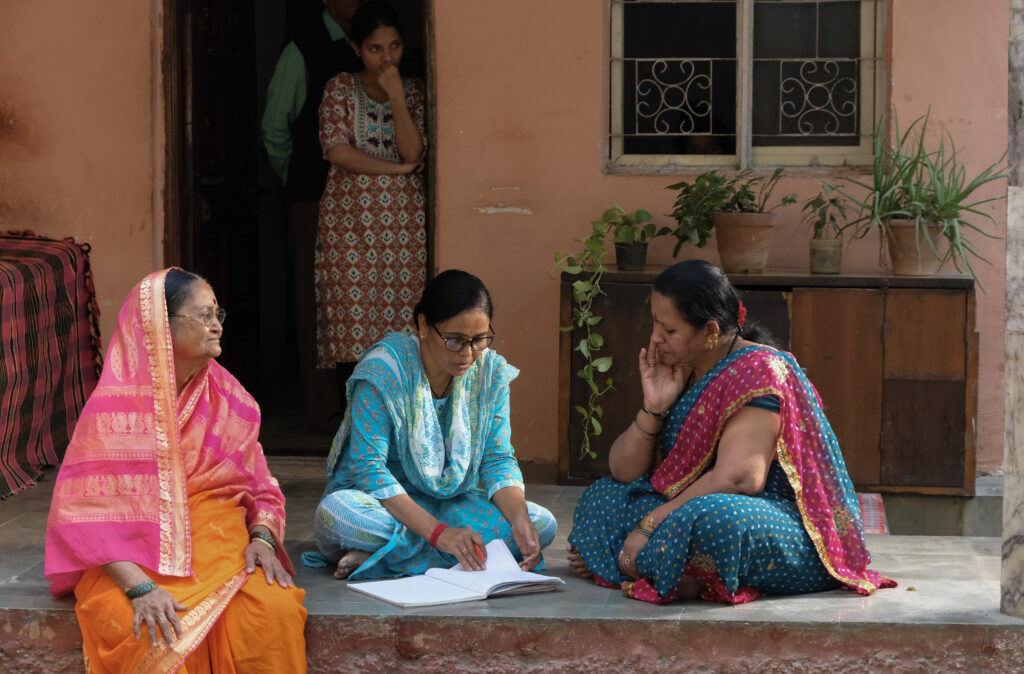
Surekha Sanjay Gaikwad, 51, is considered one of her neighbors and friends. She runs a small food market a few half hour from her home. She also reads Marathi into her phone for Karya. Sitting with Bokale on her front steps, she burst right into a wide grin when asked what she liked in regards to the experience.
“I couldn’t imagine I could do it at home,” she says. “I don’t need to get on a bus again or go anywhere else at the tip of the day.”
The education component of the work was a plus, Gaikwad said. She learned the way to create a hard and fast deposit on the bank, and she or he did just that as a solution to save more effectively for her son’s college studies.
Over the course of a recent morning, several other women who had worked for Karya stopped at Bokale’s home to talk. Meena Jadhav, 55, had used the cash to purchase material and sewing tools for her tailoring business – she made shirts to sell. Due to what she learned, she said, she will be able to now use a savings account and knows the way to use an ATM. She didn’t know you would withdraw and deposit money without going to the bank.
One other woman used the teachings she learned and the money she earned to begin a savings account for her daughter’s education.
All of them said they enjoyed the work and located the knowledge about financial planning and online tools useful. An additional benefit for the ladies, Bokale says, was learning that their smartphones could open doors to different kinds of opportunities.
She says most of the other women within the pilot project didn’t know the way to use a smartphone in any respect beforehand. “Their husbands and in-laws, they’re saying ‘Oh, you’ve learned so many latest things, and that’s so great.’”