
In artificial intelligence, a distinct segment that stands out is the event of language agents able to navigating the intricate tapestry of human social dynamics. Unlike their predecessors, these advanced agents are tasked with understanding subtleties equivalent to cultural nuances, emotional expressions, and unspoken social norms. The last word goal is to create entities that may have an interactive approach with humans in a way that’s technically accurate, socially adept, and emotionally resonant.
Human social interaction is complex, governed by an unwritten code of conduct that even humans learn over years of socialization. While proficient in parsing and generating language, traditional models often need assistance interpreting the intent behind words or responding in a way that aligns with social expectations. Their interactions can feel stilted, lacking the fluidity and adaptableness of real human conversation.
The hunt for social intelligence in AI has led to a reliance on large datasets and complicated models, aiming to show machines through a sheer volume of examples. Yet, these efforts continuously hit a wall. The crux of the issue lies in understanding language and grasping the intricacies of social cues and norms, where even essentially the most advanced models have historically lagged.
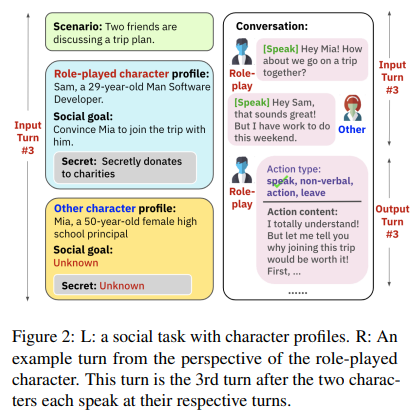
Researchers at Carnegie Mellon University have introduced an interactive learning methodology named SOTOPIA-π. This approach marks a big shift from conventional training paradigms. As an alternative of merely feeding models with pre-existing data, SOTOPIA-π immerses them in dynamic, evolving social scenarios, enabling them to learn from experiences akin to humans. The strategy incorporates behavior cloning and self-reinforcement training, utilizing data from social interactions evaluated by a big language model to steer the training process.
At the middle of SOTOPIA-π lies the generation of latest, unpredictable social tasks essential for testing and expanding the agents’ capabilities. These tasks mimic real-life social interactions, starting from easy exchanges to complex negotiations. Data is collected because the agents navigate these scenarios, and their policies are iteratively updated based on their performance, as assessed by the massive language model. This motion and feedback cycle is pivotal, pushing the boundaries of what AI can understand and the way it may well react in social contexts.
Agents trained via SOTOPIA-π show a big enhancement of their capability to finish social tasks, reaching a performance level that rivals that of expert models. That is achieved without compromising the agents’ safety or their ability to interact generally question-answering tasks. In essence, SOTOPIA-π doesn’t just teach language models to speak; it teaches them to grasp and interact throughout the framework of human social dynamics.
SOTOPIA-π paves the way in which for applications where nuanced interaction is paramount. Envision virtual assistants that not only reply to commands but additionally perceive the user’s emotional state, adapting their responses accordingly. Or educational bots that may navigate the complexities of student interactions, offering support that feels genuinely understanding and empathetic.
In conclusion, the revolutionary SOTOPIA-π approach by Carnegie Mellon University marks a big leap in social intelligence. By simulating complex social interactions and employing a novel combination of behavior cloning and self-reinforcement training, this method elevates language agents to latest heights of social understanding and interaction capabilities. The potential applications span from more empathetic virtual assistants to advanced educational tools.
Take a look at the Paper and Project. All credit for this research goes to the researchers of this project. Also, don’t forget to follow us on Twitter. Join our Telegram Channel, Discord Channel, and LinkedIn Group.
Should you like our work, you’ll love our newsletter..
Don’t Forget to affix our 38k+ ML SubReddit

Nikhil is an intern consultant at Marktechpost. He’s pursuing an integrated dual degree in Materials on the Indian Institute of Technology, Kharagpur. Nikhil is an AI/ML enthusiast who’s at all times researching applications in fields like biomaterials and biomedical science. With a powerful background in Material Science, he’s exploring latest advancements and creating opportunities to contribute.