
When a whirring sound catches your attention, you’re walking down the bustling city street, fastidiously cradling your morning coffee. Suddenly, a knee-high delivery robot zips past you on the crowded sidewalk. With remarkable dexterity, it easily avoids colliding into pedestrians, strollers, and obstructions, deftly plotting a transparent path forward. This isn’t some sci-fi scene – it’s the cutting-edge technology of GeFF flexing its capabilities right before your eyes.
So what exactly is that this GeFF, you wonder? It stands for Generalizable Neural Feature Fields, representing a possible paradigm shift in how robots perceive and interact with their complex environments. Until now, even probably the most advanced robots have struggled to interpret and adapt to the endlessly varied real-world scenes reliably. But this novel GeFF approach can have finally cracked the code.
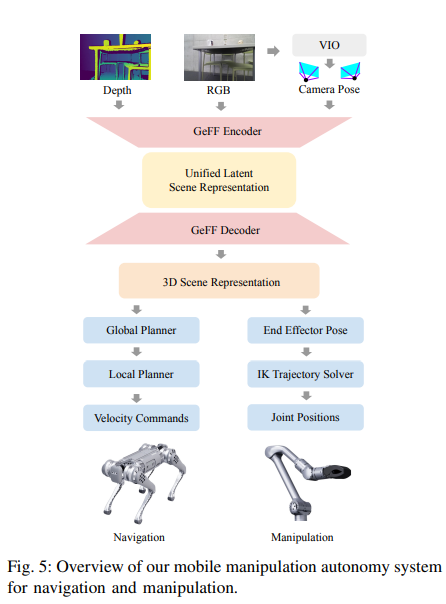
Here’s a simplified rundown of how GeFF works its magic. Traditionally, robots use sensors like cameras and lidar to capture raw data about their surroundings – detecting shapes, objects, distances, and other granular elements. GeFF takes a radically different tack. Utilizing neural networks, it analyzes the complete, wealthy 3D scene captured by RGB-D cameras. It coherently encodes the entire geometrical and semantic meaning in a single unified representation.
But GeFF isn’t merely constructing some super high-res 3D map of its environment. In an ingenious twist, it’s actually aligning that unified spatial representation with the natural language and descriptions that humans use to make sense of spaces and objects. So the robot develops a conceptual, intuitive understanding of what it’s perceiving – with the ability to contextualize a scene as “a cluttered front room with a couch, TV, side table, and a potted plant within the corner” similar to you or I’d.
The potential implications of this capability are truly mind-bending. By leveraging GeFF, robots can navigate unfamiliar, unmapped environments far more akin to how humans do – using wealthy visual and linguistic cues to reason, comprehend their surroundings, and dynamically plan unmapped paths to blazingly find their way. They’ll rapidly detect and avoid obstacles, identifying and deftly maneuvering around impediments like that cluster of pedestrians blocking the sidewalk up ahead. In perhaps probably the most remarkable application, robots powered by GeFF may even manipulate and make sense of objects they’ve never directly encountered or seen before in real-time.
This sci-fi futurism is already being realized today. GeFF is actively being deployed and tested on actual robotic systems operating in real-world environments like university labs, corporate offices, and even households. Researchers use it for various cutting-edge tasks – having robots avoid dynamic obstacles, locate and retrieve specific objects based on voice commands, perform intricate multilevel planning for navigation and manipulation, and more.
Naturally, this paradigm shift remains to be in its relative infancy, with immense room for growth and refinement. The systems’ performance must still be hardened for extreme conditions and edge cases. The underlying neural representations driving GeFF’s perception need further optimization. Integrating GeFF’s high-level planning with lower-level robotic control systems stays an intricate challenge.
But make no mistake – GeFF represents a bonafide breakthrough that might completely reshape the sector of robotics as we realize it. For the primary time, we’re catching glimpses of robots that may deeply perceive, comprehend, and make fluid decisions concerning the wealthy spatial worlds around them in a gazellelike fashion – edging us tantalizingly closer to having robots that may truly operate autonomously and naturally alongside humans.
In conclusion, GeFF stands on the forefront of innovation in robotics, offering a strong framework for scene-level perception and motion. With its ability to generalize across scenes, leverage semantic knowledge, and operate in real-time, GeFF paves the best way for a brand new era of autonomous robots able to navigating and manipulating their surroundings with unprecedented sophistication and flexibility. As research on this field continues to evolve, GeFF is poised to play a pivotal role in shaping the longer term of robotics.
Take a look at the Paper. All credit for this research goes to the researchers of this project. Also, don’t forget to follow us on Twitter. Join our Discord Channel and LinkedIn Group.
Should you like our work, you’ll love our newsletter..
Don’t Forget to affix our Telegram Channel and 38k+ ML SubReddit

Vibhanshu Patidar is a consulting intern at MarktechPost. Currently pursuing B.S. at Indian Institute of Technology (IIT) Kanpur. He’s a Robotics and Machine Learning enthusiast with a knack for unraveling the complexities of algorithms that bridge theory and practical applications.