
Vision Language Models (VLMs) emerge consequently of a novel integration of Computer Vision (CV) and Natural Language Processing (NLP). This integration seeks to mimic human-like understanding by interpreting and generating content that marries images with words, giving rise to a fancy challenge that has piqued the interest of researchers worldwide.
Recent developments have introduced models like LLaVA and BLIP-2, which capitalize on massive collections of image-text pairs to fine-tune cross-modal alignment. Advancements like LLaVA-Next and Otter-HD have focused on enhancing image resolution and token quality, enriching visual embeddings inside LLMs, and addressing the computational challenges of processing high-resolution images. Furthermore, methods reminiscent of InternLM-XComposer and auto-regressive token prediction approaches, exemplified by EMU and SEED, have sought to enable LLMs to decode images directly through extensive image-text data. While effective, these approaches have faced challenges related to latency and the necessity for large training resources.
Researchers from the Chinese University of Hong Kong and SmartMore have introduced a novel framework, Mini-Gemini, that advances VLMs by enhancing multi-modal input processing. Its distinctiveness lies in employing a dual-encoder system and a novel patch info mining technique alongside a specially curated high-quality dataset. These innovations enable Mini-Gemini to process high-resolution images effectively and generate context-rich visual and textual content, setting it other than existing models.
The methodology behind Mini-Gemini involves a dual-encoder system that features a convolutional neural network for refined image processing, enhancing visual tokens without increasing their number. It utilizes patch info mining for detailed visual cue extraction. The framework is trained on a composite dataset, combining high-quality image-text pairs and task-oriented instructions to enhance model performance and application scope. Mini-Gemini is compatible with various Large Language Models (LLMs), starting from 2B to 34B parameters, enabling efficient any-to-any inference. This setup allows Mini-Gemini to attain superior ends in zero-shot benchmarks and supports advanced multi-modal tasks.
In evaluating Mini-Gemini’s effectiveness, the framework showcased leading performance in several zero-shot benchmarks. Specifically, it surpassed the Gemini Pro model within the MM-Vet and MMBench benchmarks, scoring 79.6 and 75.6, respectively. When configured with Hermes-2-Yi-34B, Mini-Gemini achieved a remarkable 70.1 rating within the VQAT benchmark, outperforming the present LLaVA-1.5 model across all evaluated metrics. These results validate Mini-Gemini’s advanced multi-modal processing capabilities, highlighting its efficiency and precision in handling complex visual and textual tasks.
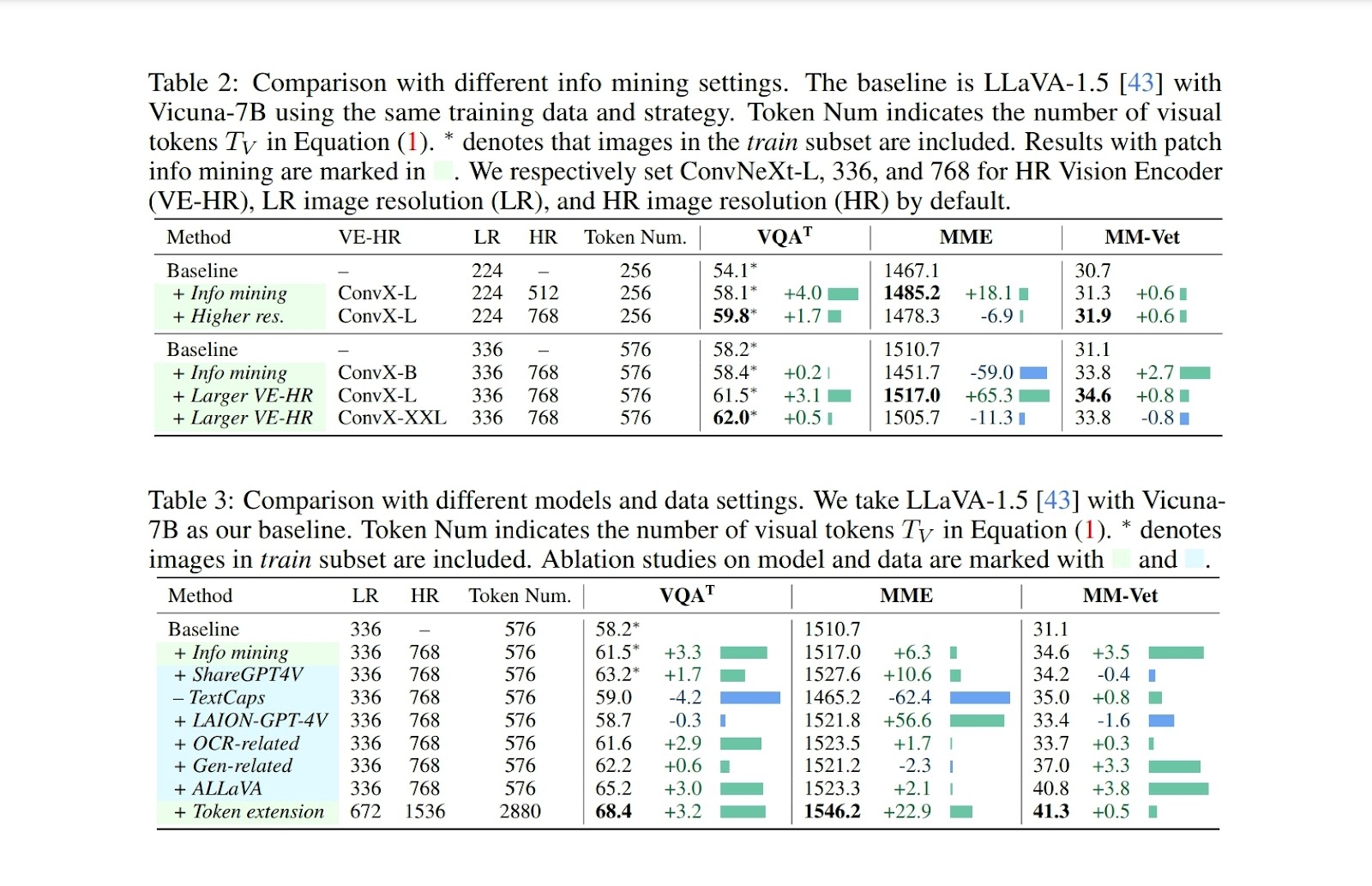
To conclude, the research introduces Mini-Gemini, which advances VLMs through a dual-encoder system, patch info mining, and a high-quality dataset. Demonstrating exceptional performance across multiple benchmarks, Mini-Gemini outperforms established models, marking a big step forward in multi-modal AI capabilities. Nonetheless, because the researchers acknowledge, there remains to be room for improvement in Mini-Gemini’s visual comprehension and reasoning abilities, and so they assert that future work will explore advanced methods for visual understanding, reasoning, and generation.
Take a look at the Paper and Github. All credit for this research goes to the researchers of this project. Also, don’t forget to follow us on Twitter. Join our Telegram Channel, Discord Channel, and LinkedIn Group.
For those who like our work, you’ll love our newsletter..
Don’t Forget to affix our 39k+ ML SubReddit

Nikhil is an intern consultant at Marktechpost. He’s pursuing an integrated dual degree in Materials on the Indian Institute of Technology, Kharagpur. Nikhil is an AI/ML enthusiast who’s at all times researching applications in fields like biomaterials and biomedical science. With a robust background in Material Science, he’s exploring latest advancements and creating opportunities to contribute.