A picture can convey an ideal deal, yet it can also be marred by various issues corresponding to motion blur, haze, noise, and low dynamic range. These problems, commonly known as degradations in low-level computer vision, can arise from difficult environmental conditions like heat or rain or from limitations of the camera itself. Image restoration represents a core challenge in computer vision, striving to get better a high-quality, clean image from one exhibiting such degradations. Image restoration is complex because there could be multiple solutions for restoring any given image. Some approaches goal specific degradations, corresponding to reducing noise or removing blur or haze.
While these methods can yield good results for particular issues, they often struggle to generalize across various kinds of degradation. Many frameworks employ a generic neural network for a wide selection of image restoration tasks, but these networks are each trained individually. The necessity for various models for every form of degradation makes this approach computationally expensive and time-consuming, resulting in a deal with All-In-One restoration models in recent developments. These models utilize a single, deep blind restoration model that addresses multiple levels and kinds of degradation, often employing degradation-specific prompts or guidance vectors to reinforce performance. Although All-In-One models typically show promising results, they still face challenges with inverse problems.
InstructIR represents a groundbreaking approach in the sector, being the primary image restoration framework designed to guide the restoration model through human-written instructions. It may possibly process natural language prompts to get better high-quality images from degraded ones, considering various degradation types. InstructIR sets a brand new standard in performance for a broad spectrum of image restoration tasks, including deraining, denoising, dehazing, deblurring, and enhancing low-light images.
This text goals to cover the InstructIR framework in depth, and we explore the mechanism, the methodology, the architecture of the framework together with its comparison with state-of-the-art image and video generation frameworks. So let’s start.
Image restoration is a fundamental problem in computer vision because it goals to get better a high-quality clean image from a picture that demonstrates degradations. In low-level computer vision, Degradations is a term used to represent unpleasant effects observed inside a picture like motion blur, haze, noise, low dynamic range, and more. The rationale why image restoration is a fancy inverse challenge is because there could be multiple different solutions for restoring any image. Some frameworks deal with specific degradations like reducing instance noise or denoising the image, while others might focus more on removing blur or deblurring, or clearing haze or dehazing.
Recent deep learning methods have displayed stronger and more consistent performance when put next to traditional image restoration methods. These deep learning image restoration models propose to make use of neural networks based on Transformers and Convolutional Neural Networks. These models might be trained independently for diverse image restoration tasks, and in addition they possess the flexibility to capture local and global feature interactions, and enhance them, leading to satisfactory and consistent performance. Although a few of these methods may go adequately for specific kinds of degradation, they typically don’t extrapolate well to various kinds of degradation. Moreover, whilst many existing frameworks use the identical neural network for a large number of image restoration tasks, every neural network formulation is trained individually. Hence, it is clear that employing a separate neural model for each conceivable degradation is impracticable and time consuming, which is why recent image restoration frameworks have focused on All-In-One restoration proxies.
All-In-One or Multi-degradation or Multi-task image restoration models are gaining popularity in the pc vision field since they’re able to restoring multiple types and levels of degradations in a picture without the necessity of coaching the models independently for every degradation. All-In-One image restoration models use a single deep blind image restoration model to tackle differing types and levels of image degradation. Different All-In-One models implement different approaches to guide the blind model to revive the degraded image, for instance, an auxiliary model to categorise the degradation or multi-dimensional guidance vectors or prompts to assist the model restore various kinds of degradation inside a picture.
With that being said, we arrive at text-based image manipulation because it has been implemented by several frameworks previously few years for text to image generation, and text-based image editing tasks. These models often utilize text prompts to explain actions or images together with diffusion-based models to generate the corresponding images. The important inspiration for the InstructIR framework is the InstructPix2Pix framework that permits the model to edit the image using user instructions that instructs the model on what motion to perform as a substitute of text labels, descriptions, or captions of the input image. Consequently, users can use natural written texts to instruct the model on what motion to perform without the necessity of providing sample images or additional image descriptions.
Constructing on these basics, the InstructIR framework is the primary ever computer vision model that employs human-written instructions to realize image restoration and solve inverse problems. For natural language prompts, the InstructIR model can get better high-quality images from their degraded counterparts and in addition takes under consideration multiple degradation types. The InstructIR framework is capable of deliver state-of-the-art performance on a big selection of image restoration tasks including image deraining, denoising, dehazing, deblurring, and low-light image enhancement. In contrast to existing works that achieve image restoration using learned guidance vectors or prompt embeddings, the InstructIR framework employs raw user prompts in text form. The InstructIR framework is capable of generalize to restoring images using human written instructions, and the only all-in-one model implemented by InstructIR covers more restoration tasks than earlier models. The next figure demonstrates the various restoration samples of the InstructIR framework.
InstructIR : Method and Architecture
At its core, the InstructIR framework consists of a text encoder and a picture model. The model uses the NAFNet framework, an efficient image restoration model that follows a U-Net architecture because the image model. Moreover, the model implements task routing techniques to learn multiple tasks using a single model successfully. The next figure illustrates the training and evaluation approach for the InstructIR framework.

Drawing inspiration from the InstructPix2Pix model, the InstructIR framework adopts human written instructions because the control mechanism since there isn’t any need for the user to offer additional information. These instructions offer an expressive and clear strategy to interact allowing users to indicate the precise location and form of degradation within the image. Moreover, using user prompts as a substitute of fixed degradation specific prompts enhances the usability and applications of the model since it could actually even be utilized by users who lack the required domain expertise. To equip the InstructIR framework with the aptitude of understanding diverse prompts, the model uses GPT-4, a big language model to create diverse requests, with ambiguous and unclear prompts removed after a filtering process.
Text Encoder
A text encoder is utilized by language models to map the user prompts to a text embedding or a set size vector representation. Traditionally, the text encoder of a CLIP model is a crucial component for text based image generation, and text based image manipulation models to encode user prompts because the CLIP framework excels in visual prompts. Nevertheless, a majority of times, user prompts for degradation feature little to no visual content, subsequently, rendering the massive CLIP encoders useless for such tasks since it’ll hamper the efficiency significantly. To tackle this issue, the InstructIR framework opts for a text-based sentence encoder that’s trained to encode sentences in a meaningful embedding space. Sentence encoders are pre-trained on tens of millions of examples and yet, are compact and efficient compared to traditional CLIP-based text encoders while having the flexibility to encode the semantics of diverse user prompts.
Text Guidance
A serious aspect of the InstructIR framework is the implementation of the encoded instruction as a control mechanism for the image model. Constructing on this, and inspired in task routing for a lot of task learning, the InstructIR framework proposes an Instruction Construction Block or ICB to enable task-specific transformations inside the model. Conventional task routing applies task-specific binary masks to channel features. Nevertheless, because the InstructIR framework doesn’t know the degradation, this system isn’t implemented directly. Moreover, for image features and the encoded instructions, the InstructIR framework applies task routing, and produces the mask using a linear-layer activated using the Sigmoid function to provide a set of weights depending on the text embeddings, thus obtaining a c-dimensional per channel binary mask. The model further enhances the conditioned features using a NAFBlock, and uses the NAFBlock and Instruction Conditioned Block to condition the features at each the encoder block and the decoder block.
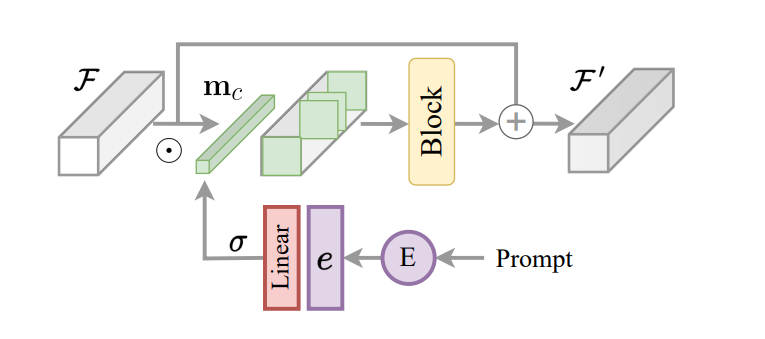
Although the InstructIR framework doesn’t condition the neural network filters explicitly, the mask facilitates the model to pick out the channels most relevant on the premise of the image instruction and data.
InstructIR: Implementation and Results
The InstructIR model is end-to-end trainable, and the image model doesn’t require pre-training. It is just the text embedding projections and classification head that should be trained. The text encoder is initialized using a BGE encoder, a BERT-like encoder that’s pre-trained on a large amount of supervised and unsupervised data for generic purpose sentence encoding. The InstructIR framework uses the NAFNet model as image model, and the architecture of NAFNet consists of a 4 level encoder decoder with various variety of blocks at each level. The model also adds 4 middle blocks between the encoder and the decoder to further enhance the features. Moreover, as a substitute of concatenating for the skip connections, the decoder implements addition, and the InstructIR model implements only the ICB or Instruction Conditioned Block for task routing only in encoder and decoder. Moving on, the InstructIR model is optimized using the loss between the restored image, and the ground-truth clean image, and the cross-entropy loss is used for intent classification head of the text encoder. The InstructIR model uses the AdamW optimizer with a batch size of 32, and a learning rate of 5e-4 for nearly 500 epochs, and in addition implements the cosine annealing learning rate decay. For the reason that image model within the InstructIR framework comprises only 16 million parameters, and there are only 100 thousand learned text projection parameters, the InstructIR framework might be easily trained on standard GPUs, thus reducing the computational costs, and increasing the applicability.
Multiple Degradation Results
For multiple degradations and multi-task restorations, the InstructIR framework defines two initial setups:
- 3D for three-degradation models to tackle degradation issues like dehazing, denoising, and deraining.
- 5D for five degradation models to tackle degradation issues like image denoising, low light enhancements, dehazing, denoising, and deraining.
The performance of 5D models are demonstrated in the next table, and compares it with state-of-the-art image restoration and all-in-one models.

As it could actually be observed, the InstructIR framework with an easy image model and just 16 million parameters can handle five different image restoration tasks successfully because of the instruction-based guidance, and delivers competitive results. The next table demonstrates the performance of the framework on 3D models, and the outcomes are comparable to the above results.

The important highlight of the InstructIR framework is instruction-based image restoration, and the next figure demonstrates the incredible abilities of the InstructIR model to grasp a wide selection of instructions for a given task. Also, for an adversarial instruction, the InstructIR model performs an identity that isn’t forced.

Final Thoughts
Image restoration is a fundamental problem in computer vision because it goals to get better a high-quality clean image from a picture that demonstrates degradations. In low-level computer vision, Degradations is a term used to represent unpleasant effects observed inside a picture like motion blur, haze, noise, low dynamic range, and more. In this text, we have now talked about InstructIR, the world’s first image restoration framework that goals to guide the image restoration model using human-written instructions. For natural language prompts, the InstructIR model can get better high-quality images from their degraded counterparts and in addition takes under consideration multiple degradation types. The InstructIR framework is capable of deliver state-of-the-art performance on a big selection of image restoration tasks including image deraining, denoising, dehazing, deblurring, and low-light image enhancement.