The Stanford Institute for Human-Centered AI recently released the 2024 edition of its highly influential AI Index report. This comprehensive study offers an in-depth have a look at the present state of artificial intelligence, analyzing key trends, advancements, and challenges across various domains. As AI continues to reshape our world at an unprecedented pace, the 2024 AI Index provides a timely and invaluable resource for understanding the complex landscape of this transformative technology.
This yr’s report is especially noteworthy for its expanded scope and depth of research. With a wealth of original data and insights, the 2024 edition delves into crucial topics comparable to the soaring costs of coaching state-of-the-art AI models, the dearth of standardization in responsible AI reporting, and the growing impact of AI on scientific discovery and the workforce. Furthermore, the report encompasses a dedicated chapter exploring AI’s influence on science and medicine, highlighting the technology’s potential to revolutionize these critical fields.
As we navigate the rapid evolution of AI, the 2024 AI Index serves as an important guide, empowering policymakers, researchers, industry leaders, and most people to make informed decisions and have interaction in constructive discussions concerning the way forward for this powerful technology.
1. AI’s Performance vs. Humans
The report highlights AI’s impressive strides in surpassing human performance across various benchmarks, comparable to image classification, visual reasoning, and English understanding. Nonetheless, it also acknowledges that AI still lags behind humans in additional complex tasks, including competition-level mathematics, visual commonsense reasoning, and planning. This nuanced assessment underscores the importance of recognizing AI’s strengths and limitations because the technology continues to evolve.
2. Industry Dominance in AI Research
In 2023, the AI industry firmly established its dominance in cutting-edge AI research. The report reveals that industry players produced a staggering 51 notable machine learning models, dwarfing academia’s contribution of just 15. Interestingly, the yr also witnessed a record high of 21 models resulting from industry-academia collaborations, signaling a growing trend of cross-sector partnerships in AI development.
Image: Stanford AI Index report
3. Rising Costs of Training State-of-the-Art Models
The AI Index report sheds light on the soaring costs related to training state-of-the-art AI models. In response to their estimates, OpenAI’s GPT-4 required a staggering $78 million value of compute resources for training, while Google’s Gemini Ultra model demanded an excellent more astronomical $191 million. These figures underscore the immense financial investments required to push the boundaries of AI capabilities and lift vital questions on the accessibility and sustainability of frontier AI research.
4. U.S. Leadership in Top AI Models
The USA has solidified its position as the worldwide leader in cutting-edge AI development, in response to the 2024 AI Index report. U.S.-based institutions were answerable for originating a formidable 61 notable AI models in 2023, far outpacing the European Union’s 21 and China’s 15. This disparity highlights the U.S.’s continued dominance in AI innovation and its ability to draw top talent and resources in the sphere.
5. Lack of Standardization in Responsible AI Reporting
As AI models grow to be increasingly powerful and influential, the necessity for responsible development and deployment practices has never been more critical. Nonetheless, the AI Index report exposes a major lack of standardization in how leading developers report on their models’ risks and limitations. Firms like OpenAI, Google, and Anthropic primarily test their models against different responsible AI benchmarks, making it difficult to systematically compare and assess the potential hazards related to these technologies. This finding underscores the urgent need for industry-wide standards and collaboration to make sure the secure and ethical development of AI.
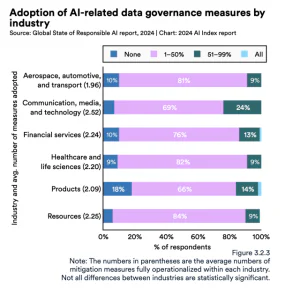
Image: Stanford AI Index
6. Surge in Generative AI Investment
While overall AI private investment experienced a decline in 2023, the generative AI sector defied this trend, witnessing a remarkable surge in funding. The report reveals that investment in generative AI nearly octupled from 2022, reaching an astounding $25.2 billion. Major players within the space, comparable to OpenAI, Anthropic, Hugging Face, and Inflection, reported substantial fundraising rounds, reflecting the growing excitement and potential surrounding generative AI technologies. This influx of capital is anticipated to fuel further innovation and competition in the sphere, as corporations race to develop more sophisticated and powerful generative models.
7. AI’s Positive Impact on Employee Productivity and Quality
The 2024 AI Index report delves into the growing body of research examining AI’s impact on the workforce. Several studies conducted in 2023 suggest that AI technologies are enabling staff to finish tasks more efficiently and to the next standard. These findings indicate that AI has the potential to reinforce human capabilities and bridge skill gaps between low- and high-skilled staff. Nonetheless, the report also cautions that utilizing AI without proper oversight and guidance can result in diminished performance, emphasizing the importance of responsible implementation and human-AI collaboration within the workplace.
8. AI Accelerating Scientific Progress
The past yr has witnessed a remarkable acceleration in the applying of AI to scientific discovery, as highlighted by the AI Index report. Constructing upon the groundbreaking AI-driven scientific advancements of 2022, 2023 saw the launch of much more transformative applications. Notable examples include AlphaDev, which optimizes algorithmic sorting efficiency, and GNoME, which streamlines the materials discovery process. These cutting-edge AI tools are revolutionizing the best way scientists approach complex problems, paving the best way for unprecedented breakthroughs across various scientific disciplines.
9. Increase in U.S. AI Regulations
As AI technologies grow to be more ubiquitous and influential, governments are grappling with the challenge of regulating their development and deployment. The AI Index report reveals a pointy increase within the variety of AI-related regulations in america over the past yr and the preceding five years. In 2023 alone, there have been 25 AI-related regulations introduced, a remarkable increase from only one in 2016. Furthermore, the entire variety of AI regulations grew by 56.3% from 2022 to 2023, reflecting the growing recognition amongst policymakers of the necessity to ascertain clear guidelines and oversight mechanisms for AI technologies.

Image: Stanford AI Index Report
10. Growing Public Awareness and Concern About AI
The 2024 AI Index report also sheds light on the evolving public perception of AI and its potential impact on society. A world survey conducted by Ipsos reveals that the proportion of people that consider AI will dramatically affect their lives inside the subsequent three to 5 years has increased from 60% to 66% over the past yr. Moreover, 52% of respondents express nervousness toward AI services and products, a major 13 percentage point rise from 2022. In america, Pew Research Center data indicates that 52% of Americans report feeling more concerned than enthusiastic about AI, up from 38% in 2022. These findings underscore the growing public awareness of AI’s transformative potential and the necessity for open, transparent dialogue to deal with the concerns and aspirations of people and communities worldwide.
Assessing the State of AI
The 2024 AI Index report offers a comprehensive and nuanced assessment of the state of AI, highlighting the rapid advancements, challenges, and societal implications of this transformative technology. From the soaring costs of coaching state-of-the-art models to the dearth of standardization in responsible AI reporting, the report underscores the necessity for collaboration, innovation, and responsible development practices to be sure that AI advantages humanity as a complete. As public awareness and concern about AI proceed to grow, it’s crucial that policymakers, researchers, industry leaders, and most people engage in informed, inclusive discussions to shape the longer term of this powerful technology. The insights provided by the AI Index report function a worthwhile resource in navigating the complex landscape of AI and charting a course toward a more equitable, sustainable, and useful AI-driven future.